Local Growth Insights
Actionable tactics on local search algorithms, proximity grids, Google Maps dominance, and high-converting acquisition.
How to Use AI Tools as Local Business Lead Generation
You want new leads. You keep hearing about artificial intelligence. But there is a massive gap between hearing about AI and actually using it to make your phone ring.Uncertainty is the enemy of growth. Many business owners are paralyzed by the technical noise surrounding AI. They wonder how a global technology applies to a neighborhood shop.Let’s clear the air.Imagine you are a roofing contractor in Melbourne. A homeowner discovers a leak after a heavy storm. They do not search for "roofing contractor." They pick up their phone and ask, "Who is the best emergency roof repair service near me that is open right now?"Google’s AI Overviews and tools like Gemini do not just scan for keywords anymore. They act as answer engines. They synthesize data to recommend exactly one or two businesses. If your digital presence is not optimized for this shift, the AI recommends the competitor down the street.This guide breaks down the exact, practical steps to use AI for local business lead generation. No fluff. Just universal SEO principles that work in any market.The Shift: From Blue Links to AI RecommendationsSearch has changed. We are moving from traditional Search Engine Optimization (SEO) to Generative Engine Optimization (GEO).Users used to scroll through ten blue links. Now, AI models summarize the best options at the top of the page. To capture these high-intent leads, you must understand how AI decides who gets recommended.AI looks for trust, clarity, and real-world validation. It pulls data from three primary sources:1. Your Google Business Profile (GBP):This is your local anchor. AI systems rely heavily on your GBP to verify your existence, location, and services.2.Local Map Packs:Showing up in the top three map results remains critical. AI frequently pulls map pack data to answer proximity-based queries.3.Citations and Directories:Consistent Name, Address, and Phone number (NAP) data across the web builds entity authority. If your business information is mismatched on different directories, the AI loses trust and skips you.To win new leads, your data must be structured perfectly. AI hates ambiguity.Practical Applications Steps to Generate New Leads with AI ToolsHow do you actually use AI to get more customers? Here are the most effective, practical applications for local businesses right now.1. Automating Conversational Lead CaptureTraffic means nothing if it does not convert. When a potential customer lands on your website at 11:00 PM, they want answers immediately.Conversational AI is your 24/7 sales representative. Unlike old, clunky chatbots that force users through rigid menus, conversational AI understands natural language.If a user types, "Do you offer financing for full roof replacements?", the AI understands the context. It can answer the question, ask for their contact information, and instantly book an inspection directly into your calendar.Do this if you don’t have it: Implement an AI-driven chat widget on your site. Train it on your specific FAQs, pricing models, and service areas. This captures leads while you sleep.2. Predictive Keyword ResearchTraditional keyword research tells you what people searched for last month. AI predicts what they will search for tomorrow.AI tools analyze massive datasets to uncover long-tail, conversational queries. People speak to voice assistants differently than they type. They ask complete questions.Instead of targeting "roofing," AI reveals that your ideal customers are asking, "How much does it cost to fix a burst pipe on a weekend?"Action Step:Use AI SEO tools to map out question-based keywords. Build dedicated pages on your website answering these exact questions. This feeds the AI engines exactly what they need to recommend you.3. Scaling Review ManagementReviews are the lifeblood of local SEO. AI heavily weighs customer sentiment when making recommendations.Generating and responding to reviews takes time. AI streamlines this. Automated systems can send personalized review requests to customers immediately after a job is completed via SMS or email.When a review comes in, AI can draft a professional, context-aware response.Action Step:Connect your CRM to an AI review management tool. Set it to auto-draft responses for your Google Business Profile. You just hit approve. This keeps your profile active and signals to Google that you care about customer experience.Understanding Entity Authority To Win in AI Local SearchTo win in AI-driven local search, you must build "Entity Authority." An entity is a singular, unique, well-defined thing or concept. In this case, your business is the entity. AI models map relationships between entities.If your roofing business is frequently mentioned alongside terms like "reliable," "Melbourne," "slate roof repair," and "certified," the AI builds a strong, positive association. It categorizes your business as a highly relevant entity for those topics.How do you build this a lead generation system with AI?Digital PR:Get mentioned in local news outlets and neighborhood blogs.Sponsorships:Sponsor local events or sports teams. The backlinks from these local organizations signal deep community ties to the AI.Hyper-Local Content:Write case studies about specific jobs in specific neighborhoods. Mention the local climate challenges or building codes.This proves to the AI that you are not just a website, but a real, active participant in the local economy.What Local Businesses Are Also Asking You are not alone in your uncertainty. Here are the most common "People Also Ask" questions and trending queries regarding AI and local lead generation, answered by experts.How can AI improve local SEO for small businesses?AI levels the playing field. It makes optimization faster and more efficient. AI tools automate tedious tasks like citation management, keyword clustering, and review analysis. nstead of guessing what works, AI highlights exactly where a business should focus its resources to dominate the local map pack. It analyzes search patterns and flags inconsistencies in your local listings before they hurt your rankings.What is the difference between traditional Local SEO and AI Local SEO?Traditional local SEO relies on manual updates. You build static location pages, manually update directories, and chase exact-match keywords. AI Local SEO is predictive and intent-based. It leverages machine learning to anticipate search trends and automates real-time data updates across hundreds of directories. AI SEO focuses on structuring your website data so Large Language Models (LLMs) can easily read, verify, and recommend your business.How do I use AI for local lead generation without losing my brand's voice?The golden rule: Use AI as your research assistant, not your spokesperson. AI is brilliant at analyzing data, suggesting conversational keywords, and generating content outlines. However, a human must always review the tone and add local context. If you let AI write your website copy unchecked, it will sound robotic. Inject your own expertise, local neighborhood references, and real customer stories into the AI-generated framework.Which AI tools are best for generating local business leads?The right toolkit depends on your specific needs, but a few categories are essential. For content and SEO, tools that analyze semantic search and entity authority are vital. For direct lead capture, conversational AI platforms that integrate with your website and social media messaging are highly effective. For local presence, AI-driven listing management software ensures your citations remain perfectly consistent across the web.Futureproof Action Plan to Build an AI Lead Generating SystemInformation without execution is useless. Here is your blueprint to start generating new leads using AI today.Step 1: Clean Your Digital FootprintAI models cross-reference data. If your business address on your website does not match your Google Business Profile or your local chamber of commerce listing, the AI gets confused. Confused AI does not recommend your business. Run an automated citation audit. Fix every mismatched Name, Address, and Phone number (NAP) online.Step 2: Optimize for Semantic SearchStop stuffing keywords. Start answering questions. Look at the exact services you provide. Create deep, detailed content for each service. Structure your website with clear headers, bullet points, and FAQ sections. Implement LocalBusiness schema markup. When an AI crawls your site, it should instantly understand who you are, what you do, and where you do it.Step 3: Dominate the Map Pack with VelocityReview velocity matters. It is not just about having 500 reviews; it is about getting a steady stream of new reviews every week. Automate your review requests. Make it frictionless for a happy customer to leave a five-star rating on your GBP.Step 4: Deploy a Lead Capture AgentStop letting website visitors bounce. Install a conversational AI agent on your homepage. Program it to ask qualifying questions. What is your timeline? What is your budget? What is your postal code? Route these pre-qualified leads directly to your sales team.Step 5: Leverage Predictive AnalyticsUse AI to analyze historical search data and forecast demand. If you know emergency repair queries spike in November, optimize your GBP offers and Q&A sections in October. AI allows you to be proactive rather than reactive.SummaryUncertainty regarding AI is normal, but inaction is fatal. Artificial intelligence is not a passing trend; it is the new foundation of local business discovery.You do not need a massive capital investment to start. You need a strategic approach. Focus on structuring your data, answering real customer questions, and automating your lead capture.By aligning your local SEO strategy with how AI engines actually work, you stop chasing algorithms. You start capturing high-intent leads. The businesses that embrace this shift today will dominate their local markets tomorrow.
Read Article
How to Write Google Reviews That Actually Help You Rank in Ask Maps
If you ask most business owners what makes a good Google review, they will say a five-star rating and a positive comment. That instinct made sense when reviews were primarily a social proof signal something human visitors read to build confidence before making a decision.It still makes sense for that purpose. But reviews now serve a second function that most businesses have not accounted for: they are data inputs that Gemini reads to answer conversational queries in Ask Maps.When a user asks Ask Maps "find me a reliable electrician who does emergency call-outs," Gemini processes the review text across matching business profiles to find evidence of real-world reliability and emergency availability. A business with dozens of reviews that say "great service, highly recommend" provides almost no useful signal for that query. A business with reviews that mention emergency call-outs, response times, and job outcomes provides exactly the kind of signal Ask Maps needs to include that business in its answer.The gap between these two profiles is not about review volume. It is about reviewing content.What Ask Maps actually looks for in reviewsUnderstanding the difference between a review that helps you rank and one that does not requires understanding what Gemini is trying to extract from review text.Specific service or product mentions. Generic praise tells Gemini that customers were satisfied. It does not tell Gemini what they were satisfied with. Reviews that name specific services, products, or job types "the full rewire of our three-bedroom house," "the emergency boiler repair on a Sunday evening," "the bridal updo and makeup for a morning wedding" give Gemini concrete, matchable information.Real-world experience descriptors. Ask Maps is designed to answer questions about what it is actually like to use a business. Reviews that describe the experience wait times, booking process, atmosphere, staff behaviour, physical environment provide this context. "Waited less than ten minutes to be seen," "the waiting room was calm and quiet," "the engineer called ahead to confirm arrival time" these details are the raw material of a confident conversational answer.Outcome language. Reviews that describe what happened after the service are particularly valuable. "The boiler has been running perfectly for six months since the repair," "my skin cleared up within two weeks of starting the treatment," "the website they built has already brought in three new client enquiries" outcome statements give Gemini evidence of real results, not just customer satisfaction.Location and context signals. Reviews that mention the neighbourhood, the type of property, or the specific circumstances of the job help Ask Maps match the review content to location-specific or context-specific queries. "They came out to our Victorian terrace in [neighbourhood]" or "we needed someone who could work in a listed building" are the kinds of contextual details that help local queries find the right match.Review language that works across different industriesThe principles above apply across sectors, but the specific language that drives visibility varies by business type. Here are examples of high-value review language for different categories.Trades and home services: Reviews that mention the type of job, the property type, the urgency level, the materials used, and the tidiness of the work. "Fixed our leaking flat roof on a Victorian mid-terrace, completed in one day, left the site completely clean" gives Ask Maps something to work with for roof repair queries in a specific property category.Hospitality: Reviews that mention specific dishes, dietary accommodations, occasion type, table location, noise level, and service style. "The lamb shank was the best we've had outside of a specialist restaurant. Quiet enough for a conversation on a Saturday evening."Health and wellness: Reviews that describe the presenting issue, the treatment approach, and the outcome. "Came in with chronic lower back pain from desk work. After four sessions of sports massage I was back to running without pain." This gives Gemini specific, matchable health condition and outcome language.Professional services: Reviews that describe the business situation, the service provided, and the measurable result. "They handled our company's first VAT return when we crossed the threshold clear explanations throughout, no unexpected fees, submitted on time." This maps directly to queries from businesses in the same situation.How to encourage better reviews from your customersThe challenge is not just knowing what good reviews look like. It is building a consistent process that generates them.Timing is the most important variable. The best moment to request a review is immediately after a positive experience when the detail is fresh, the customer is satisfied, and the goodwill is at its peak. For service businesses, that is at the point of job completion. For hospitality, it is at the end of the visit. For professional services, it is at the conclusion of a successful engagement. A review request sent two weeks later is working against fading memory and fading motivation.The channel matters. SMS review requests consistently outperform email for response rate, particularly for service businesses where the customer interaction was in person. A short SMS with a direct link to your Google review page sent within an hour of the job completion is the most effective format for most trade and service businesses. Email works well for professional services and e-commerce where the customer relationship is more considered and the review request can be part of a follow-up communication.The request itself shapes the review. You cannot tell customers what to write and Google's review policies prohibit incentivising specific review content. But you can frame the request in a way that naturally prompts detail. "We'd love it if you could share a few words about your experience, particularly what the job involved and how it went" is a legitimate, policy-compliant prompt that encourages more specific responses than "please leave us a five-star review."Responding to reviews reinforces semantic signals. When you respond to a review, your response becomes part of the text that Gemini reads. Responses that restate the specific service and outcome "Thank you for sharing that, we're glad the emergency boiler repair on Sunday evening got your heating back on quickly" reinforce and extend the semantic content of the review. This is a legitimate and underused signal amplification strategy.What to do with your existing reviewsDo not overlook the review base you already have. Read through your most recent fifty reviews and assess them against the criteria above. Identify the ones that provide specific, detailed, outcome-oriented content; these are your signal anchors. Identify the gaps: which services or job types are never mentioned? Which aspects of your customer experience are consistently absent from review content?Use those gaps to inform your review request strategy. If your emergency call-out service is never mentioned in reviews despite being a key part of your business, adjust your review request timing and framing for emergency jobs to make it more likely that customers describe that specific experience.The goal is not to manufacture reviews. It is to build a process that naturally generates the kind of authentic, specific, experience-based content that helps Gemini and your prospective customers understand what your business does and how well it does it.
7 Proven Local SEO Strategies to Dominate Abia State's Digital Market
In today's hyper-competitive digital landscape, local businesses in Abia State must secure top search visibility to survive and scale. Partnering with a premier SEO agency in Umuahia is no longer a luxury, but a strategic necessity to capture high-intent customers at the exact moment they are ready to buy.Local Search Dominance: Over 46% of all Google searches have local intent, making regional search engine optimization critical for brick-and-mortar success in Abia State.Google Business Profile (GBP) Mastery: A fully optimized, actively managed GBP is the single most powerful driver of foot traffic, direction requests, and phone calls in Umuahia.Hyper-Local Keyword Targeting: Bypassing generic national keywords to target high-converting, geo-specific phrases yields an immediate and measurable return on investment (ROI).Technical Local Authority: Building localized backlinks and ensuring consistent NAP (Name, Address, Phone) data establishes trust with search engines, cementing your business at the top of the Google Map Pack.In the bustling commercial hubs of Umuahia from the busy trade routes of the Main Market to the corporate offices around Library Avenue and the administrative layouts of the Government Station a silent revolution is taking place. Traditional advertising channels like radio jingles, billboards, and flyers are losing their grip on the local market. Today, when a consumer in Umuahia needs a reliable service, a medical specialist, a high-quality hotel, or a real estate consultant, they do not ask around; they consult their smartphones.If your business does not appear on the first page of Google when someone searches for your industry in Abia State, you are effectively invisible. This is where a dedicated SEO agency in Umuahia becomes your most valuable growth partner. By leveraging advanced search engine optimization strategies, local businesses can position themselves directly in front of active buyers. Working with a qualified local SEO expert in Nigeria ensures your digital presence is engineered to convert online searches into physical store visits and bank deposits.7 Pillars of Local SEO Success for Umuahia BusinessesTo dominate search engine results pages (SERPs) in Abia State, you need a structured, multi-dimensional framework. Here is the definitive 7-step playbook that a top-tier SEO agency uses to position local brands for long-term digital authority. 1. Google Business Profile (GBP) OptimizationYour Google Business Profile (formerly Google My Business) is the cornerstone of your local digital footprint. When users search for services "near me" or in "Umuahia," Google displays the local Map Pack, a prominent box showing the top three local businesses.To claim your spot in the coveted Map Pack, your GBP must be meticulously optimized: Complete Every Section: Fill out your business name, exact physical address, local phone number, website URL, and operating hours. Select Precise Categories: Choose a primary category that accurately defines your business (e.g., "Hotel in Umuahia" rather than just "Business") and utilize highly relevant subcategories. Publish High-Resolution Photos: Upload geotagged images of your storefront, interior, products, and team. This builds trust with both Google's algorithm and potential customers.2. Hyper-Local Keyword Research & TargetingGeneric keywords like "best fashion designer" are highly competitive and attract searchers from across the globe. A localized keyword strategy focuses on terms that Umuahia residents actually type into search engines.An experienced local SEO expert in Nigeria will target transactional, long-tail search terms such as: "Best private schools in Umuahia" "Real estate agents in Umuahia Abia State" "Affordable dental clinics near Library Avenue Umuahia"By optimizing your website's content for these specific phrases, you attract highly qualified traffic that is much further along in the buying cycle.3. On-Page Local SEO and Schema MarkupOn-page SEO involves optimizing individual pages on your website to rank higher and earn more relevant traffic. For local businesses, this means embedding geographic modifiers naturally into your title tags, meta descriptions, header tags (H1, H2, H3), and body copy.Furthermore, implementing Local Business Schema Markup (structured data code added to your website) is non-negotiable. Schema tells search engine crawlers exactly what your business does, where you are located, and how your services are structured, allowing Google to display rich snippets of your business in search results.4. NAP Consistency Across Online DirectoriesNAP stands for Name, Address, and Phone number. Search engines value consistency above almost all else when validating local businesses. If your business is listed as "Umuahia Digital Hub" on your website, but appears as "Umuahia Digital Hub Ltd" on Facebook and "UDH Hub" on local directories, Google's algorithm becomes confused about your true identity.An SEO agency in Umuahia will conduct a comprehensive citation audit, correcting mismatched information across high-authority Nigerian business directories like VConnect, Yalwa, BusinessList, and local Abia State business listings.5. Mobile-First Optimization for the Nigerian MarketNigeria is a mobile-first nation. The vast majority of internet users in Umuahia access search engines via mobile networks (MTN, Airtel, Glo, 9mobile). If your website is slow to load, difficult to navigate on a smartphone, or consumes excessive data, users will bounce back to the search results instantly.Local search optimization requires a responsive web design, compressed images, clean code, and fast server response times. Google uses mobile-first indexing, meaning it ranks your desktop site based on how well your mobile site performs.6. Localized Content MarketingTo build topical authority, your website must publish content that directly addresses the needs, challenges, and interests of the local community. Instead of generic industry blog posts, write about topics relevant to Abia State: A construction firm could write about: "Building Materials Prices in Umuahia: A Comprehensive Guide." A law firm could publish: "Understanding Land Acquisition Laws in Abia State."This localized content signals to Google that you are an active, deeply integrated participant in the local economy, boosting your overall domain authority.7. Strategic Review Acquisition and Reputation ManagementOnline reviews are the modern equivalent of word-of-mouth recommendations. Google uses the quantity, frequency, and diversity of your customer reviews as a major ranking factor in the local Map Pack.An effective local SEO campaign includes a systematic process for requesting reviews from satisfied customers. Promptly responding to every review, both positive and negative demonstrates exceptional customer service and signals activity to search engine algorithms. Expert Insight: "Many Nigerian business owners mistakenly believe that running social media ads is enough. While social ads push your brand to passive users, local SEO positions your business in front of active searchers who are holding their debit cards, ready to make a purchase. SEO is a long-term asset that builds compounding equity over time, unlike paid ads which stop delivering leads the moment you stop paying."How to position your online business to win in Umuahia Implementing SEO in Umuahia, Abia State, requires a deep understanding of local market dynamics and consumer behavior. Unlike Lagos or Abuja, Umuahia's digital ecosystem is still maturing, presenting a massive first-mover advantage for businesses that act now.To succeed in this region, your SEO strategy must account for:Many consumers in Abia State research online but complete purchases offline. Your website must make phone numbers, WhatsApp click-to-chat buttons, and physical directions highly visible to facilitate this transition.Trust and Credibility Barriers: Online skepticism is high in Nigeria. Overcome this by prominently displaying local trust seals, physical office photos, customer video testimonials, and clear refund or service guarantee policies on your landing pages.Power and Connectivity Realities: Given intermittent power supply and fluctuating internet speeds in parts of Abia State, your website must be lightweight and highly optimized for low-bandwidth connections.ConclusionThe digital landscape of Abia State is evolving rapidly. As internet penetration deepens and mobile usage continues to skyrocket, the businesses that invest in high-authority local SEO today will dominate the market tomorrow. Letting your competitors claim the top spots on Google is a recipe for long-term decline.At Localeadr, we specialize in transforming online visibility into predictable revenue. Our team of search engine optimization experts understands the nuances of the Nigerian digital market and knows exactly what it takes to get your business found by customers searching for you online.
How Enugu Hotels Can Claim the Top Spots on Google Maps without OTA's.
Walk into any premium hospitality property in Enugu whether it’s a luxury boutique setup tucked away in Independence Layout, a high-occupancy business suite in New Haven, or a serene getaway near Nike Lake and you’ll see massive investments in physical excellence. Hoteliers spend millions on premium Italian tiling, heavy-duty soundproof windows, sprawling conference facilities, and industrial-grade backup power plants to ensure 24/7 electricity.Yet, many of these same properties are completely invisible where it matters most: on the digital screens of high-intent travelers.Before an international corporate delegation lands at the Akanu Ibiam International Airport, or a diaspora family packs their bags for an event in Coal City, they open their smartphones. They don't browse physical flyers or look for billboards along the Enugu-Onitsha expressway. They search. Currently, the vast majority of local hotels outsource their entire visibility strategy to Online Travel Agencies (OTAs) like Booking.com or Expedia. While these platforms provide bookings, they demand massive commissions often ranging from 15% to 25% per stay. You do all the heavy lifting of maintenance, staffing, and power generation, while an algorithm in Europe takes a massive cut of your profit.Local search engine optimization (SEO) is the mechanism that changes this dynamic. By building localized search dominance, you open a digital front door that brings guest relationships and premium room margins straight to your direct booking engine.How the Proximity Search System Work for Hotels When a traveler searches for accommodation while on the move, Google rewrites its standard Search Engine Results Page (SERP). It bypasses regular directory links and displays the Local 3-Pack: a dedicated map block paired with three elite local business profiles.To secure one of these high-value positions inside the Enugu market, your digital presence must align with the three pillars of Google’s local search algorithm:1. ProximityThis measures how close your property is to the user making the query, or the specific neighborhood area they type into the search bar. If a user inputs "hotels near Polo Park Mall" or "boutique suites near Government House", Google scans geographic coordinate data to serve the most immediate physical matches.2. RelevanceRelevance determines how well your business profile answers what the user is actually looking for. If an executive searches for a "hotel with a conference hall and fiber internet in Enugu," a basic website layout with just photos won't suffice. The search engine requires structured technical data to confidently match your hotel to that exact intent.3. ProminenceProminence reflects your hotel's overall authority across the web. Google measures this by looking at your local review signals, the frequency of your digital brand mentions on travel portals, and the foundational domain authority of your main website.The Schema Type you need for your hotel websiteTo outrank aggressive third-party directories, you have to feed search engines the exact structured format they crave. Modern search crawlers and AI answer engines do not read your web pages like human guests; they scan your source code for clean, machine-readable validation.This validation is achieved through JSON-LD Schema Markup. By injecting a specialized Hotel data block into the header of your website, you stop letting search engines guess your rates, coordinates, and operational amenities.How to Dominate the Google Business Profile (GBP) FeedYour Google Business Profile isn’t just an online business card, it is a live data node that connects your physical building to the global travel grid. For hospitality brands looking to capture local demand in Enugu State, optimization requires active management:Activate Direct-Booking Verification: Google allows hotels to bypass standard OTA fees by linking verified booking engines directly into their map profiles. This places an official "Book Direct" price badge right alongside major aggregators, driving guests straight to your merchant pipeline.Leverage Local Attribute Mapping: Fill out every available checkbox in your dashboard. Explicitly declare your safety measures, physical access points, pool availability, and your power setup. In a market where travelers regularly search for reliable infrastructure, ticking the box for "Bar/Lounge" or "24-Hour Power" can be the difference between winning a booking or being filtered out.Geotag Your Visual Assets: Regularly upload raw, high-resolution smartphone photography of your rooms, restaurant menus, and external property views. Ensure these images contain embedded local spatial data, helping search algorithms map your visual proof directly to search queries from neighborhoods like Trans-Ekulu, Achara Layout, or Bisalla Road.General digital agencies often treat search visibility as a one-size-fits-all formula, applying identical tactics whether they are promoting a shop in Lagos or a corporate brand in Abuja. But regional hospitality requires a deep local context.At Localeadr, we focus entirely on building unshakeable local market authority. We know the exact difference between positioning an executive suite on Presidential Road versus optimizing an estate near the Nike Lake corridor. We understand the search habits, trust barriers, and structural realities that drive Eastern Nigeria’s commercial landscape.We handle the heavy technical lifting from hardcoding custom schema architectures to managing local citation profiles so your hotel can bypass expensive third-party platforms and start owning its guest relationships directly.Are you curious about how visible your property actually is to potential travelers right now? Don't leave your occupancy rates to guesswork. Use our interactive SEO ROI Calculator to how many local inquiries your hotel can start getting when you have a SEO marketing campaign running.
Back Button Hijacking Penalty: June 15 Deadline Is Approaching — Is Your Site at Risk?
Google has set a hard deadline of June 15, 2026 for a new penalty targeting back button hijacking, a practice where websites use JavaScript to manipulate or block the browser's back button, trapping users inside artificial navigation loops they did not choose to enter.If your site uses any form of JS-driven back navigation blocking, you have a limited window to identify and remove it before enforcement begins.This is not a grey area. Google has been explicit about what it is targeting and why. And unlike many algorithmic quality signals that operate gradually and without announcement, this one has a specific enforcement date which means the risk of inaction is unusually well-defined.What back button hijacking actually isThe browser back button is one of the most fundamental navigation controls on the web. Users rely on it to return to where they came from whether that is the search results page, a previous article, or a different website entirely. It is an expectation that is so deeply embedded in how people use the internet that violating it creates immediate frustration and distrust.Back button hijacking occurs when a website uses JavaScript to intercept or override this expected behaviour. The most common implementations include:Forced redirect loops. When a user presses the back button, instead of returning to the previous page, the site pushes a new entry into the browser's history stack, sending the user to a different internal page, often a promotional landing page, an email capture form, or a checkout flow. Pressing back again triggers another redirect, and the user is effectively trapped.Exit-intent interstitials that manipulate history. Some implementations use history.pushState() to add artificial entries to the browser history before displaying an exit-intent popup. When the user tries to leave by pressing back, they encounter the popup rather than the previous page.Pop-up and overlay loops. A variant where pressing the back button dismisses a popup but does not navigate away from the page, and pressing back again triggers another popup in a different format creating a carousel of interruptions rather than genuine navigation.All of these practices prioritise the site's conversion goals over the user's navigation intent. Google's enforcement signals that this trade-off is no longer acceptable.How to check whether your site is affectedThe most reliable way to test for back button hijacking is manual browser testing combined with a review of your JavaScript codebase.Manual testing: On each of your key landing pages particularly homepage, product pages, and any pages that use exit-intent or conversion optimisation tools open the page and immediately press the browser back button. Note what happens. If you are returned to the previous page in your browsing history, navigation is working correctly. If you are redirected to a different page on the same site, shown a popup, or find that pressing back multiple times does not successfully navigate away from the site, you have an implementation that needs to be reviewed.JavaScript audit: Search your codebase and the code of any third-party scripts loaded on your site for uses of history.pushState(), history.replaceState(), and window.onpopstate. These are not inherently problematic they are standard browser APIs used legitimately in single-page applications and many interactive interfaces. The issue is when they are used specifically to intercept back navigation for conversion purposes. Review each use in context and assess whether it interferes with the user's ability to navigate away from the page.Third-party scripts: This is where many sites are caught out. Exit-intent popup tools, conversion rate optimization platforms, chat widgets, and some analytics implementations include back-navigation manipulation in their default configurations. The fact that the code comes from a third-party vendor does not exempt your site from the penalty Google evaluates the behaviour, not the source. Review the behaviour of every conversion-focused third-party script on your site.How to fix itRemove or replace the manipulative behaviour. If your exit-intent tool or conversion overlay relies on back button interception, work with your vendor to disable that specific feature or find a compliant alternative. Most reputable CRO platforms have already moved away from back-navigation manipulation in response to Google's guidance check with your vendor for their recommended compliant configuration.Replace navigation traps with compliant conversion tools. Exit-intent popups that trigger on mouse movement toward the browser's address bar or tab bar rather than on back button press are a compliant alternative that achieves similar conversion goals without hijacking navigation. Scroll-triggered overlays, time-delayed offers, and sticky notification bars are all compliant approaches to capturing user attention before exit.Test after remediation. Once you have made changes, repeat the manual back button test on every affected page type. Test in multiple browsers. Confirm that pressing back from any page on your site returns the user to their previous location in browser history without interception.If you are already penalised: If your site has already seen a ranking drop that you believe is related to this issue, fix the code first, then submit the affected URLs for reconsideration via Google Search Console. Document the changes you made and when.The broader pattern: Google's UX-first enforcement trendBack button hijacking is the latest in a sequence of user experience penalties that Google has introduced over recent years. Intrusive interstitials were penalised in 2017. Core Web Vitals including Cumulative Layout Shift, which penalises unexpected layout movement became a ranking factor in 2021. The ongoing enforcement of page experience signals reflects a consistent policy direction: practices that prioritise site owner goals over user experience carry ranking risk.While you are in your JavaScript codebase reviewing back navigation behaviour, it is worth auditing for other UX patterns that carry similar risk. Aggressive interstitials that block content immediately on page load, fake countdown timers on promotional pages, and navigation structures that make it difficult to reach key information without triggering conversion overlays are all in territory that Google's quality evaluators are paying attention to.The June 15 deadline makes back button hijacking the immediate priority. But the audit process it triggers is worth extending more broadly as part of a systematic UX compliance review.Act this weekJune 15 is close. The identification and remediation process for most sites is straightforward, but it requires time for development, testing, and deployment particularly if your site uses a third-party vendor whose configuration needs to be changed.Identify the issue this week. Fix it in the next two weeks. Test it thoroughly before the enforcement date. That timeline is achievable for most sites if work begins now.[local-seo-estimator]
Localeadr vs. Legacy Lagos Agencies: Why Specialized SEO Beats Broad Digital Marketing
When a B2B enterprise, professional service firm, or high-value property developer in Nigeria prepares a marketing budget, the default instinct is often to look toward the massive creative blocks in Ikoyi, Lekki, or Victoria Island. For years, legacy Lagos digital marketing agencies were considered the gold standard for corporate visibility.But as we navigate the data-driven landscape of 2026, many business executives are facing a frustrating realization: High creative retainers do not automatically translate to baseline business revenue.The Nigerian advertising sector is experiencing a significant shift. According to recent 2026 market intelligence data from the Nigeria Advertising Conference (NAC), businesses under economic pressure are heavily shifting their demands away from general awareness toward direct attribution.For B2B brands where customer acquisition relies on high-trust, bottom-of-the-funnel intent, the traditional multi-channel agency model is proving to be an expensive, slow-moving vehicle.If you are a B2B decision-maker comparing growth partners to optimize for return on investment (ROI), here is a transparent, structural analysis of how legacy full-service Lagos agencies compare against a specialized technical search engine partner like Localeadr (LLR Digital).1. Retainer Costs vs. Performance ArchitectureThe most immediate friction point for B2B brands evaluating full-service Lagos agencies is the entry cost. Tier-1 legacy agencies carry heavy operational overheads, with standard monthly retainers starting anywhere from ₦1.5 Million to over ₦10 Million depending on campaign scope.For consumer packaged goods (FMCG) or telecom giants, these budgets are justifiable to maintain broad, nationwide household visibility. However, for a B2B brand looking for high-intent corporate clients or international property investors, paying for massive creative teams often means funding services you don't actually need. You end up paying for graphic design packages, social media community management, and radio or PR outreach when your actual buyers are searching for technical solutions on Google, Perplexity, or ChatGPT.Localeadr completely strips away this structural overhead. We focus our performance fee entirely on asset discovery and conversion optimization, meaning every single naira spent goes directly into building permanent search moats, schema graph deployments, and intent-focused content silos that generate direct client inquiries.2. Fragmented Attention vs. Laser-Focused Search Data ExtractionBecause legacy agencies position themselves as "full-service" providers under one roof, their internal attention is inherently divided across multiple marketing channels. On any given week, their teams are balancing social media grids, billboard placements, radio scripts, and event activations. Consequently, technical search engine optimization is frequently treated as an afterthought often outsourced to generalized freelancers or confined to basic meta tag plug-ins.Localeadr approaches growth strictly as a technical and behavioral data challenge. We don't guess what your audience wants based on broad lifestyle trends. We utilize direct search data extraction from platforms like Google Search Console and hyper-local search grid matrices to map exactly what your highest-value clients are searching for at the bottom of the conversion funnel. Every piece of text, schema script, and layout we build is engineered specifically to make your site the most authoritative answer to those user queries.3. Approval Bottlenecks vs. "Vibe Coding" Deployment SpeedTraditional digital marketing agencies are historically slow to execute. A new landing page or specialized content asset typically requires passing through graphic design teams, copywriting boards, account managers, and legal reviews a workflow that can consume weeks before a single page goes live.In the fast-moving 2026 tech corridor, this delay represents lost revenue. Localeadr bypasses this administrative bottleneck by utilizing an agile software development methodology known as "vibe coding."By leveraging advanced generative coding setups and structured modular design frameworks, our growth engineers can build, test, and deploy high-fidelity landing pages and fully operational lead-capture systems within hours rather than weeks. This allows your brand to capitalize on immediate market shifts, test search niches rapidly, and deploy real estate guides or service funnels at a speed that traditional agencies simply cannot match.Cutting Corporate Overhead: The Growth Engineering AlternativeOperational VariableLegacy Full-Service Lagos AgenciesLocaleadr Growth EngineeringTypical Monthly RetainerHigh (₦1.5M – ₦10M+ due to massive corporate overhead)Value-Aligned (Focused entirely on technical asset performance)Core Marketing FocusTop-of-funnel awareness, creative videos, & social gridsBottom-of-funnel intent, Technical SEO, & AI Visibility (GEO)Landing Page DeploymentSlow (4 to 8 weeks through multi-tier creative chains)Rapid (Hours to days using modern agile "vibe coding" speed)Attribution & ReportingVanity metrics (Impressions, post engagement, clicks)Direct business data (Form submissions, direct calls, trackable ROI)Ecosystem DepthGeneralized across all business typesDeeply integrated into specialized tech models (e.g., Realinkr)Moving ForwardThe choice between a full-service legacy giant and a specialized technical growth partner comes down to how your business model captures revenue:If your brand requires a massive lifestyle presence, celebrity influencer tie-ins, and high-budget visual storytelling to reach millions of everyday consumers, the scale of a legacy Lagos agency is built for your needs.But if you are a B2B enterprise, a tech startup, or a property developer looking to close multi-million naira transactions with serious local and diaspora buyers, you do not need broad lifestyle noise. You need target search dominance, automated machine trust, and high-velocity digital deployment.By prioritizing deep technical SEO data over surface-level metrics, Localeadr (LLR Digital) constructs the permanent organic pipelines your company needs to turn online intent into predictable business growth.
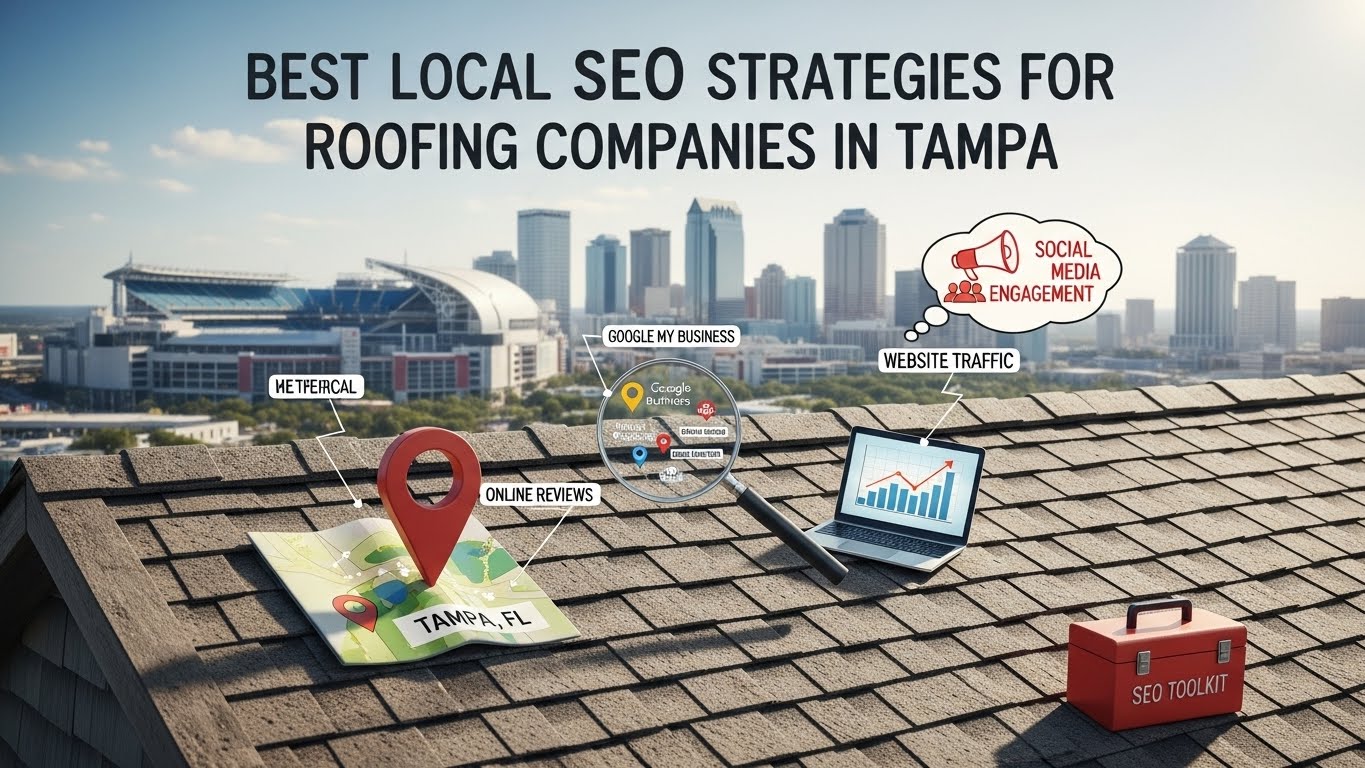
Best local SEO strategies for roofing companies in Tampa
If your Tampa roofing company isn’t showing in the Google Map Pack, your competitors are getting the calls, even if your work is better and your prices are fairer.Local SEO for roofers isn’t about "blogging more" or chasing junk backlinks from overseas. It’s about sending Google the right local trust signals so your business shows up exactly when a homeowner in South Tampa or Brandon searches “roof repair Tampa” or “roofing company near me.”Below are the local SEO strategies that actually move the needle for roofing companies in Tampa.Why Local SEO Matters More Than Organic Rankings for Tampa RoofersMost high-intent roofing searches in Tampa trigger the Google Local Pack. That’s the map section that sits above the organic links, featuring:Direct "Call" buttonsOne-tap DirectionsSocial Proof (Reviews)Homeowners dealing with active leaks, hurricane damage, or urgent insurance claims don’t scroll past the first three map results. They click, they call, and they book.Ranking #1 organically but #5 in Maps still means you are invisible to the most profitable leads.1. Choose the Correct Google Business Profile CategoriesThis is where most roofers fail before they even start. Your Primary Category is the single most important ranking factor for the Map Pack.Primary Category: Roofing ContractorSecondary Categories: * Roof RepairRoof ReplacementWater Damage Restoration (Only if you actually do it)Gutter Installation Pro Tip: Do not add "General Contractor" unless that is your main bread and butter. It dilutes your authority. Category selection directly affects how high a roofing company ranks in the Tampa Local Pack.2. Optimize Service Areas for Tampa! Not the Whole StateMany roofing companies try to "cast a net" over the entire state of Florida. Google sees this as a lack of focus, and it actually shrinks your visibility.Better Approach: Be the Local AuthorityLimit your service areas in your Google Business Profile to:Tampa, Brandon, Riverview, Carrollwood, and Temple Terrace.Why it works: Proximity is the #1 ranking factor. If Google thinks you are "everywhere," they won't rank you "anywhere" specifically. Support these specific locations with dedicated content on your site.3. Create Tampa-Specific Roofing Service PagesIf your website is just a digital brochure, it's useless for SEO. Your site must serve as the "evidence" that backs up your Google Business Profile.Required Pages for Tampa Roofers:Roof Repair in Tampa (Focus on common local leaks)Tampa Roof Replacement (Focus on permitting and local codes)Storm Damage Restoration Tampa (Focus on insurance claim assistance)Each page should include:References to Tampa’s unique weather (High-UV exposure, afternoon thunderstorms, hurricane season).Hyper-local internal links: Roof Repair in Tampa → /roof-repair-tampa/4. Write a Roofing-Focused Business Description with Tampa ContextYour business description isn't a place for your mission statement. It’s a place for keywords and context.The Formula:Mention who you are, what you do, and exactly where you do it.“We’re a family-owned, licensed Tampa roofing company specializing in shingle and tile roof repairs, full replacements, and hurricane damage restoration across Hillsborough County.”5. Use Roofing Job Photos That Build Local TrustGoogle’s "Vision AI" scans your photos. If you use a stock photo of a house in Ohio with a chimney and snow, Google knows it's not a Tampa home.Upload Real-World Photos:The "Truck Shot": Your branded truck parked in front of a recognizable Tampa street.The "Damage Shot": Close-ups of hail or wind damage on a local roof.The "Team Shot": Your crew in branded gear on a job site in Brandon or Riverview.Why this works: Real photos build "Local Entity" proof. Google trusts a roofer who regularly uploads geotagged photos from their service area.6. Build Review Velocity After Every Roofing JobGoogle doesn't just look at your star rating; it looks at Velocity (how often you get reviews) and Keywords within the reviews.The "Map Pack" Review Strategy:Ask immediately: Before the crew leaves the driveway.Guide the customer: Ask them to mention the service. “Could you mention we did a shingle replacement in South Tampa?”Respond to everyone: Use your response to reinforce your location. "Glad we could help with your Tampa roof repair, Mike!"7. Make Your Website Support Google Maps RankingsYour website and your Map listing are a team. If they don't say the same thing, you won't rank.The Essentials:NAP Consistency: Name, Address, and Phone must be identical everywhere.Google Map Embed: Put your physical office location on your Contact page.Location Schema: Hidden code that tells Google’s bots exactly where your office is located.8. Build Roofing-Specific Local CitationsA "citation" is just a mention of your business on another site. But don't waste time on random directories.Prioritize:Hyper-Local: Tampa Bay Business Journal, The City Experience or local Chamber directories.Hyper-Industry: GAF Certified, Owens Corning, or the Florida Roofing and Sheet Metal Contractors Association (FRSA).Reality Check: 10 relevant roofing and Tampa-based citations are worth more than 500 random ones.Common Local SEO Mistakes Tampa Roofers MakeIf you aren't ranking, you're likely doing one of these:Keyword Stuffing your Name: Adding "Best Roofers Tampa" to your business name (Risk of suspension).Linking to the Homepage only: Your "Roof Repair" listing should link to your "Roof Repair" page.Ghosting your Reviews: Not replying to customers makes you look inactive to Google.Using a PO Box: Google rarely ranks businesses that don't have a real, physical office in the city.ConclusionThe best local SEO strategies for roofing companies in Tampa focus on relevance over reach. You don't need to rank in Orlando or Miami. You need to dominate the 15-mile radius around your office. By aligning your Google Business Profile with Tampa-specific website pages and consistent review growth, your visibility can realistically improve within 30–90 days.That’s how local SEO turns into calls, not just reports.Ready to See How Your Website Performs in Tampa? Don’t guess if your site is holding back your Map Pack rankings. Get a professional roofing website audit today and uncover exactly what’s stopping your business from showing up in Google Maps.
AI Reasoning Mode and Citations: Why Being Found at the Comparison Stage Is the New Rank 1
There is a version of SEO strategy that treats search as a series of discrete queries each one a standalone event where a user types something, Google returns results, and the highest-ranking page gets the click. In that model, the goal is straightforward: rank as high as possible for the right keywords, and traffic follows.That model is becoming obsolete.The shift is being driven by something most marketers have not yet fully internalised: AI systems increasingly handle complex user research through extended reasoning a mode in which a single query triggers a multi-step investigation, generating dozens of sub-queries, consulting multiple sources, and synthesising a comprehensive answer across what was previously a multi-session, multi-search journey.In this model, the question is not "do we rank for this keyword?" It is "are we present in the research process that this query triggers?" And the data on how that research process works reveals a clear strategic priority.What extended reasoning mode actually doesWhen an AI search system operates in standard inference mode processing a query and returning a direct answer it draws on a relatively limited set of sources. Research into AI citation behaviour shows that standard inference produces citations at a rate of around 50%, drawing from an average of 2.6 sources per response across approximately 127 unique domains.Extended or high-reasoning mode is triggered by complex, multi-part, or comparative queries. A user asking "what is the best type of boiler for a Victorian mid-terrace with no existing gas connection?" or "compare the main SEO strategies for a local service business trying to rank in AI Overviews" is making a request that a standard inference pass cannot fully address. The system recognises the complexity and activates a deeper research process.Under extended reasoning, the citation rate rises from 50% to 68%. The average sources per response nearly doubles to 4.5. The number of unique domains referenced expands from 127 to 173. And the number of sub-queries generated the individual research questions the AI poses to itself to build a comprehensive answer multiplies 4.6 times, reaching an average of around 24 sub-queries for some complex prompts.This is not a single search. It is a research programme. And the brands that appear consistently across the sub-queries in that research programme maintain visibility throughout the journey. The brands that are absent from those sub-queries even if they rank well for individual keywords in traditional search are invisible to the AI's research process.Why the comparison and selection stages matter mostAI-driven research journeys follow a recognisable structure, even when they happen inside a single query response. The AI moves through awareness (what exists?), research (what are the options?), comparison (how do they differ?), and selection (which is best for my situation?).The comparison and selection stages generate the most sub-queries and draw on the widest range of sources. This is where the AI is actively weighing alternatives, seeking evidence of relative performance, and looking for the specific details that distinguish one option from another. It is also where brand presence most directly influences the recommendation that the user ultimately receives.Research into brand continuity across AI reasoning journeys found that in standard inference mode, zero out of twenty simulated purchase journeys resulted in consistent brand presence from awareness to conversion. Under extended reasoning, four out of twenty journeys maintained brand presence throughout. That jump from zero to four was entirely driven by whether the brand had content that appeared during the comparison and selection sub-queries.The implication is direct. Brands that invest in comparison-stage content, explicit comparisons, detailed use-case analysis, structured "best for" assessments are the brands that enter reasoning-mode research journeys and stay in them.What content enters AI reasoning-mode researchUnderstanding what kind of content gets cited during extended reasoning helps clarify the content investment priority.Explicit comparison content is the highest-priority category. Pages that directly compare two or more options "gas boiler vs heat pump for period properties," "agency SEO vs in-house SEO for growing businesses," "WordPress vs Webflow for service business sites" are exactly the type of content that reasoning-mode AI seeks out during the comparison stage. The page that provides a clear, fair, well-structured comparison of the relevant options is more likely to be cited than a page that asserts one option is best without exploring the alternatives.Use-case specific content is the next priority. Content that connects a specific situation to a specific recommendation "the best approach to local SEO for multi-location trades businesses" or "how to choose a commercial kitchen supplier when scaling from one to five sites" matches the specificity of the sub-queries that reasoning-mode AI generates. Generic "what is local SEO" content is relevant at the awareness stage. Specific, situation-oriented content is relevant at the comparison and selection stages where most citations occur.Evidence-based content content that draws on original research, case studies, data, or first-hand expertise is consistently favoured by reasoning-mode AI over opinion-led or summary content. A page that includes actual data, documented results, or clearly attributed expert knowledge provides the kind of reliable reference that an AI system constructing a comprehensive answer can cite with confidence.How to build a citation strategy for the comparison stageMap your content against the research journey. For each of your primary service or product categories, identify what an AI system would need to cover in order to answer a complex user query about that category from awareness through to selection. What comparisons would it make? What use cases would it address? What evidence would it seek? The gaps in your current content against that map are your citation strategy priorities.Create explicit comparison and alternative-assessment content. If you currently have no pages that directly compare your offering against alternatives or that compare different approaches within your category this is the highest-priority gap to close. These pages do not need to be promotional. In fact, the most citable comparison content is balanced, acknowledges the genuine strengths of alternatives, and focuses on helping the reader understand which option suits which situation. Balanced comparison content is more trustworthy to an AI system than one-sided advocacy.Build topical depth across the comparison stage. A single comparison page is a start, but a topical cluster that covers a subject from multiple angles, multiple comparison pages, use-case guides, detailed FAQs, expert commentary creates a much stronger presence across the sub-queries that reasoning-mode AI generates. The AI is not consulting one page per research programme. It is consulting multiple sources across multiple sub-queries. A deep topical cluster gives you multiple entry points into that process.Implement entity signals. Reasoning-mode AI has a higher citation rate for brands that can be verified as genuine entities that have consistent information across their website, Knowledge Graph presence, structured schema, and social profiles. Ambiguous or inconsistently represented brands are harder for AI systems to cite confidently. A clear, consistent entity footprint is a prerequisite for reliable citation at scale.Measuring your reasoning-mode citation visibilityMonitoring citation performance is not yet as straightforward as monitoring traditional keyword rankings, but several approaches give useful signals.Search Console's AI Mode performance data now integrated into standard performance totals shows impressions and citations from AI-driven search experiences. Pages with high AI Overview impressions and low click-through rates are likely being cited in reasoning-mode research without triggering a visit. Pages with growing AI-driven clicks are the ones where your citation presence is actively converting.For more granular tracking, testing AI systems directly with comparison-style queries in your category and monitoring whether your brand appears in the response is a practical monitoring approach. Run the same queries monthly and track whether your citation frequency and position in responses is improving.The benchmark to build toward is consistent presence across the comparison and selection stages of AI research journeys in your category. Brands that reach that benchmark will have a structural visibility advantage that compounds over time because the AI systems that conduct reasoning-mode research learn, over many interactions, which sources provide reliable, citable information and return to them consistently.
Top SEO & Digital Growth Agency in Umuahia, Abia State
For generations, dominating the commercial market in South-East Nigeria meant relying completely on physical footprint, word-of-mouth networks, and traditional offline distribution. But as the regional economy undergoes a massive digital transformation, the competitive landscape has completely changed.Today, whether you are a scaling MSME, a rising tech startup, or a real estate developer looking to attract international buyers, your primary storefront is no longer just a physical address, it is your search engine visibility.At Localeadr (LLR Digital), we serve as the premier organic growth engine for businesses looking to scale within the regional market and beyond. We don't just optimize for basic keywords; we construct the technical data pipelines and content systems needed to command market share and secure customer trust.Why Umuahia Businesses Need Enterprise-Grade Search InfrastructureThe economic momentum across Abia State is accelerating at a historic pace. Driven by strategic infrastructure developments, streamlined investment frameworks, and structural policy overhauls, Abia State has surged to 11th place nationally in the Ease of Doing Business rankings.From the emergence of the Manu-Tech UniPod innovation facility at MOUAU (Umudike) to the growing commercial networks connecting Umuahia and Aba, a new generation of forward-thinking businesses is scaling out of the state capital.However, local visibility has evolved past simple social media management. Running short-lived, expensive Facebook or Instagram ad campaigns creates an unpredictable revenue model. To build a permanent growth moat, local enterprises must show up exactly where high-intent buyers are looking: inside traditional search engine results and conversational AI responses.Our Local Moat: How We Engineer Regional Market DominanceWe don't rely on generic marketing templates. We build specialized, localized search systems tailored directly to the dynamics of the South-East commercial ecosystem:1. Local Search Grid & Map Pack DominanceWe optimize your Google Business Profile (GBP) and local citations so your business completely dominates the local map pack for ready-to-buy consumers in Umuahia, Aba, and neighboring hubs. We align your physical location data with your web presence to drive immediate inbound phone calls and foot traffic.2. High-Intent Content Silos for Regional ScalingWe map your content strategies to hard search data, not assumptions. By building tight, interconnected content clusters that target specific commercial and geographic intents, we position your website as the absolute topical authority in your industry.3. Cross-Border & Diaspora Visibility EngineeringFor high-value sectors like real estate, your target market isn't just local; it includes a massive, eager diaspora investor base in the UK, US, and Europe. By pairing our advanced search architectures with secure listing infrastructures like our proprietary Realinkr platform, we help regional brands present transparent, data-backed opportunities directly to overseas buyers.Performance Matrix: Broad Digital Marketing vs. Localeadr Growth SystemsGrowth VectorBroad Digital AgenciesLocaleadr Umuahia HubPrimary GoalSocial media vanity likes & generic trafficConversions, search engine dominance, & organic revenueAI ReadinessIgnored (Relies on outdated image/text fliers)Native GEO (Optimized for ChatGPT, Perplexity, & Gemini)Geographic TargetGeneric national broad targetingHyper-local map packs & specialized diaspora pipelinesAsset ValueTemporary visibility that disappears when ad spend stopsPermanent digital assets that compound over timeMoving ForwardTrue business growth in the modern economy requires a clean, machine-readable, and highly authoritative digital presence that search platforms and artificial intelligence models cannot ignore. As Umuahia solidifies its position as a primary innovation hub along the South-East corridor, Localeadr provides the data-driven systems and technical expertise needed to turn organic search into your most predictable scaling asset.
Showing 73–81 of 96 articles