Local Growth Insights
Actionable tactics on local search algorithms, proximity grids, Google Maps dominance, and high-converting acquisition.
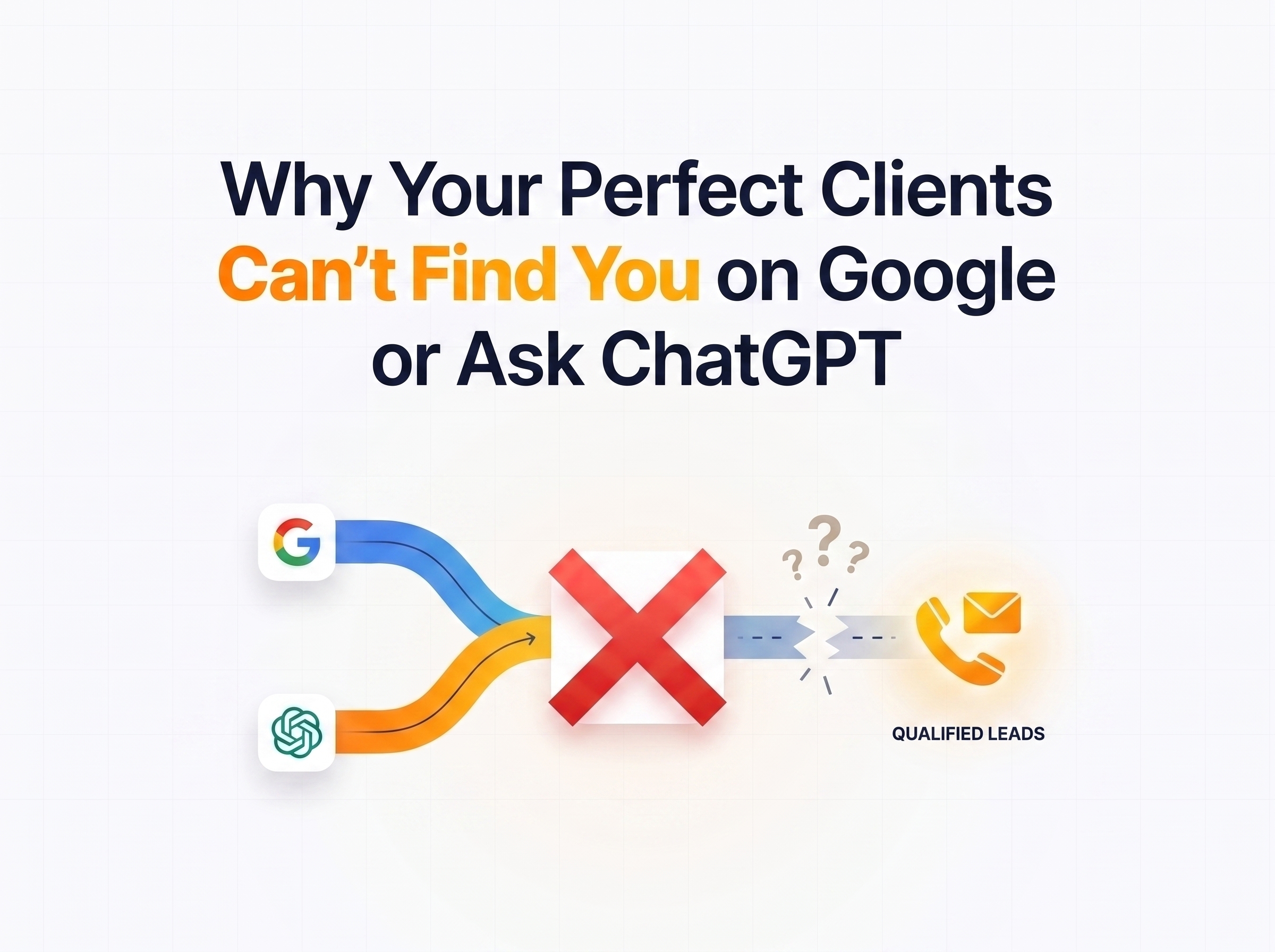
Why Your Next Customer Can't Find You on Google or Ask ChatGPT
Key Takeaways Modern buyers leverage AI search to create "silent shortlists," often eliminating brands before traditional marketing engagement. Traditional click-based marketing funnels are broken due to high zero-click rates in AI-driven search results. Brands must optimize for AI synthesis by ensuring their digital footprint is machine-readable, authoritative, and cited across platforms. Marketing budgets are inefficiently spent on vanity clicks and siloed strategies; focus must shift to foundational trust signals and "Share of Model" (SoM). Success in the AI era requires realigning strategy to provide concise, authoritative answers that AI engines can directly recommend to high-intent prospects. It’s 9:15 AM. Your ideal client, the high-value lead you’ve spent thousands of dollars trying to target with retargeting ads, top-of-funnel ebooks, and general PPC campaigns isn't scrolling through your carefully built funnels. Instead, they opened Google or ChatGPT and typed: "What is the best enterprise solution for X, and who actually delivers results without a 6-month onboarding window?" Within 1.5 seconds, the AI engine synthesized dozens of sources, reviewed real customer sentiment, evaluated entity authority, and handed them a curated answer. Before they ever click a single blue link or land on a traditional marketing page, they have already built a "silent shortlist." If your brand wasn't named in that synthesized answer, you didn't just lose a click. You were eliminated from the buying process before it even began. Meanwhile, your marketing budget continues to bleed out on strategies built for 2021. Here is why this shift is happening right now, why traditional marketing budgets are draining fast, and how you can realign your strategy to win in the era of AI search. The End of the Traditional Funnel: Zero-Click & AI Shortlists For over a decade, digital marketing operated on a simple exchange: publish content → rank on page 1 of Google → capture the click → collect an email → nurture the lead. That exchange is fundamentally broken. Over 64% of Google searches now end in zero clicks: Google AI Overviews and featured snippets answer the query directly on the search results page. Conversational AI search engines operate with 78% to 93% zero-click rates: Platforms like ChatGPT, Perplexity, and Google AI Mode prioritize direct synthesis over sending users down a rabbit hole of website clicks. The "Silent Shortlist" phenomenon: Modern buyers ask AI engines complex, multi-layered questions to evaluate vendors long before reaching out to sales. When your prospective clients use search or AI today, they aren't looking for broad 2,000-word fluff articles. They are seeking fast, authoritative consensus. If your digital footprint isn't machine-readable or cited across touchpoints, AI engines simply won't recommend you. Where Your Marketing Budget Is Actually Draining If your cost-per-acquisition (CPA) is creeping up while conversion rates stall, your budget is likely leaking through three major structural holes: Chasing High-Volume, Low-Intent "Vanity Clicks" Paying for broad keywords or pouring resources into generic top-of-funnel blog posts ("What is X?") no longer works. AI engines summarize basic definitions instantly. If your content relies on answering surface-level questions, users digest the summary and bounce, draining your ad spend or content budget without driving revenue. Treating SEO and AI Search as Disconnected Silos Splitting your budget between traditional SEO, expensive "AI search growth hacks," and isolated ad channels burns money. Large language models (LLMs) and Google's AI models rely on the same fundamental trust signals: entity authority, clean structured data, digital PR, and verified customer proof. Measuring Clicks Instead of "Share of Model" (SoM) If your primary success metric is still total organic sessions, you are tracking a declining asset. Raw traffic volume is down across the web, but referral quality from AI searches is significantly higher—post-AI click visitors convert up to 23% better because they arrive fully informed. Measuring success by surface-level pageviews leads to cutting tactics that actually drive high-intent deals. How to Plug the Leak: A 4-Step Action Blueprint To stop the budget drain and ensure your brand appears front and center when prospective buyers query Google or ChatGPT, pivot your marketing execution toward these core focus areas: Action Pillar What to Eliminate What to Build Instead Content Strategy Generic 2,000-word definition articles Proprietary data, original case studies, and clear Q&A formatting Technical Footprint Bloated pages and missing metadata Clean Schema markup (JSON-LD) and clear entity associations Distribution Isolated blog publishing Ecosystem presence: Reddit, industry review hubs, podcasts, and digital PR KPI Tracking Raw traffic volume & click-through rates Share of Model (SoM), pipeline influence, and revenue per referral Step 1: Optimize for "Answer Engine Readiness" Structure key landing pages and insights to give direct answers upfront. Lead with clear, declarative statements within the first 200 words, backed by structured FAQ data and verified stats. AI models prefer citing source material that presents facts directly without fluff. Step 2: Build Brand & Entity Authority Beyond Your Site ChatGPT and Google AI Overviews don't just read your website; they evaluate what the broader web says about you. Invest in digital PR, get featured on respected podcasts, earn reviews on major platforms, and engage in key community forums. When AI scans the Web to form an opinion, positive consensus across third-party sources guarantees your spot on the shortlist. Step 3: Shift Paid Spend to High-Intent "Decision Phase" Queries Reallocate budget away from broad discovery keywords. Focus paid campaigns spend strictly on high-intent comparison, brand defense, and solution-seeking queries where users are ready to take action. Step 4: Track Your Brand's "Share of Model" Audit how LLMs respond to high-intent questions in your niche. Prompt ChatGPT, Perplexity, and Google AI with real buyer questions monthly. Track how often your brand is cited versus competitors, and refine your authority messaging based on where AI tools draw their data. Frequently Asked Questions What is the "silent shortlist" phenomenon in AI search? It refers to how modern buyers use AI engines like Google AI Overviews or ChatGPT to synthesize information and evaluate vendors, forming a list of preferred solutions *before* ever clicking a website or engaging with traditional marketing funnels. Why are traditional marketing funnels no longer effective in the AI era? Traditional funnels rely on capturing clicks, but AI search engines increasingly provide direct answers (zero-click results). This means users get their information and make purchasing decisions without needing to visit a brand's website. How can brands ensure they are recommended by AI search engines? Brands need a machine-readable digital footprint, strong entity authority, clean structured data, verified customer proof, and consistent citations across various touchpoints. This allows AI engines to confidently synthesize and recommend them as authoritative sources. What is "Share of Model" (SoM) and why is it a crucial new metric? "Share of Model" measures how often your brand is included in AI-generated answers or recommendations. It's vital because AI-referred visitors are typically higher quality and convert significantly better, making it a more valuable indicator of success than raw traffic volume. Where are marketing budgets commonly being wasted in the current landscape? Budgets are often drained by chasing high-volume, low-intent "vanity clicks" from generic keywords, treating traditional SEO and AI search as disconnected strategies, and measuring success solely by outdated traffic metrics instead of AI recommendations. Moving Forward Your perfect clients haven't stopped searching; they've just stopped clicking on search clutter. They want fast, accurate, synthesised answers to complex problems. By shifting your marketing budget away from high-volume click-chasing and anchoring your strategy in entity authority, clear structural data, and ecosystem visibility, you plug the budget leak and guarantee that when your buyers ask AI for a recommendation, your name is the answer.
7 Google Business Profile Fields You're Probably Leaving Blank
Key Takeaways Google's Ask Maps (launched March 2026) fundamentally changes local search, prioritizing detailed Google Business Profile (GBP) data over proximity. Many businesses overlook critical GBP fields beyond basic information, significantly hindering their visibility in conversational search queries. Optimizing fields like Accessibility Attributes, Seating Options, and Service Descriptions is vital for Ask Maps to confidently match your business to specific user needs. A comprehensive and attribute-rich GBP can enable businesses to outrank closer competitors by providing more confident answers to user questions. Regularly reviewing and completing the 'More' tab in your GBP dashboard is essential for maximizing local search visibility. Most businesses set up their Google Business Profile once, fill in the obvious fields—name, address, phone number, opening hours—and move on. The profile becomes a static listing that gets updated occasionally when something important changes. That approach was manageable when Google Maps ranked results primarily on proximity and keyword match. It is a liability now that Ask Maps has arrived. Ask Maps, Google's conversational local search layer launched in March 2026, uses Gemini to process natural language queries against more than 300 million business profiles. It does not rank businesses by distance first. It ranks them by how well their profile data answers the user's specific question. A business with a complete, detailed, attribute-rich profile can outrank a competitor located closer to the user, simply because its profile provides a more confident answer. The difference between appearing and not appearing often comes down to GBP optimization fields that most businesses have never filled in. Here are the seven most commonly ignored Google Business Profile fields and how to fix each one. How to Check Your Profile Before You Start Before working through the list below, open your Google Business Profile dashboard and navigate to Edit Profile. Work through each section tab: Business Information Location Contact Hours More The More tab is where most of the underused attribute fields live. It is the section most businesses skip entirely during setup and never return to. Keep a note of every field you find blank or incomplete, as these are common profile issues that hinder your visibility. That is your priority fix list. Seven Critical Profile Fields to Optimize 1. Accessibility Attributes Why it matters now: Conversational queries like "find me a restaurant that's wheelchair accessible" or "dentist with hearing loop near me" are exactly the type of question Ask Maps is built to answer. If your accessibility attributes are blank, your business cannot be a confident answer to those queries—regardless of how close you are to the user. What to fill in: Wheelchair-accessible entrance, wheelchair-accessible seating, wheelchair-accessible car park, hearing loop availability, accessible toilet. Select every attribute that genuinely applies to your premises. If you are unsure about any, verify with your facilities manager before adding; inaccurate accessibility information causes real harm to users who depend on it. 2. Outdoor and Indoor Seating Why it matters now: Hospitality and food businesses consistently see high-volume conversational queries around seating environments—"somewhere with a beer garden", "café with outdoor tables", "restaurant you can sit outside". These queries cannot be answered confidently from proximity alone. What to fill in: Outdoor seating, indoor seating. If you have outdoor seating, add specificity in your business description: covered or uncovered, heated, dog-friendly, capacity. The attribute field signals availability; your description provides the detail that makes the answer compelling. 3. Service Types and Menu Descriptions Why it matters now: The services section of a Google Business Profile is one of the most powerful and underused fields available. Ask Maps reads service descriptions to match conversational queries. A plumber who lists "emergency boiler repair — same-day call-out available for gas leaks, no-heat situations, and burst pipes" is a far more useful answer to "I need an emergency plumber tonight" than one who lists "plumbing services." What to fill in: Every service you offer, individually listed with a description. Write each description in conversational language that mirrors how a customer would phrase the request. Avoid internal jargon. Write for the query, not for the category. For hospitality businesses, menu descriptions that name specific dishes, dietary options, and cuisine style all contribute to conversational match. 4. Parking Options Why it matters now: Parking availability is a frequent qualifier in local search decisions, particularly for businesses in city centres or areas with limited street parking. Users asking "dentist with free parking" or "restaurant near a car park" are filtered by this attribute before they consider anything else. What to fill in: Free parking lot, paid parking lot, free street parking, paid street parking, valet parking. If parking is available nearby but not directly on your premises, note this in your business description. The attribute signals what you have; the description can clarify proximity and cost. 5. Health and Safety Attributes Why it matters now: For healthcare, childcare, food service, and personal care businesses, health and safety standards are active decision factors for many users. Ask Maps can surface businesses that meet specific standards when a user's query implies concern for hygiene, safety, or certification. What to fill in: Staff wear masks (if applicable and accurate), appointment required, temperature checks (if applicable), enhanced cleaning. Only add attributes that accurately reflect your current practices. Inaccurate health and safety attributes damage trust significantly when users arrive and find the reality does not match the profile. 6. Payment Methods Why it matters now: "Does this place take cards?" is one of the most common pre-visit questions for local businesses. A profile that does not specify accepted payment methods forces users to guess, call ahead, or choose a competitor whose profile is clearer. As Ask Maps answers these questions conversationally, payment method specificity becomes a filtering criterion. What to fill in: Credit cards, debit cards, NFC mobile payments (Apple Pay, Google Pay), cash only (if applicable). If you have recently started accepting contactless or have stopped accepting cash, update this field immediately. Outdated payment information is one of the most common sources of negative review mentions about local businesses. 7. Business Description with Natural Language Why it matters now: The business description field has a 750-character limit and most businesses use it to stuff keywords they hope will improve map rankings. That approach is increasingly counterproductive. Ask Maps reads descriptions as natural language and evaluates whether they answer a user's question—not whether they contain specific keywords. What to write: A clear, specific, conversational description of what your business does, who it serves, what makes it distinct, and what a customer can expect. Write it as if you were answering the question: "what should I know about this business before I visit?" Mention your primary services, your location context (neighbourhood, landmark proximity), your typical customer, and anything that genuinely differentiates you. Avoid generic phrases like "quality service" and "competitive prices"; they add no meaning and take up space that specificity could fill. Implementation Timeline and ROI For most businesses, a thorough audit and update of all seven areas can be completed in two to three hours. The services section typically takes the longest, because writing good conversational service descriptions requires thought rather than just clicking checkboxes. The return on that time investment is disproportionate to the effort, especially when integrated into your broader local SEO strategy. Profile completeness is one of the most direct inputs to Ask Maps visibility, and it is entirely within your control. Unlike ranking factors that depend on third-party links or algorithmic decisions, your profile attributes are yours to configure correctly right now. The businesses that complete this work first will build a structural advantage that compounds over time as Ask Maps adoption grows and conversational local search becomes the dominant way users discover local services. The Quick Audit Checklist Run through this before you close your GBP dashboard today: [ ] All accessibility attributes relevant to your premises are selected and accurate [ ] Outdoor and indoor seating is specified (hospitality businesses) [ ] Every service has an individual listing with a conversational description [ ] Parking options are specified with type and cost [ ] Health and safety attributes reflect your current practices [ ] All accepted payment methods are selected and up to date [ ] Business description uses natural language, not keyword lists, and is at or near the 750-character limit
Inside Localeadr | Local SEO Agency in Umuahia
Key Takeaways Many local businesses in Umuahia are invisible to customers searching online, missing out on high-intent local leads. Localeadr is a local SEO agency in Umuahia dedicated to improving business visibility across Google Search, Google Maps, and local search results. The agency's approach focuses on understanding local search intent, optimizing for key discovery channels, and aligning SEO efforts with tangible business goals like increased calls, leads, and store visits. Localeadr offers a comprehensive suite of local SEO services, including keyword research, website optimization, content strategy, citations, reputation management, and competitor analysis. Local SEO strategies are customized for different business types in Umuahia, recognizing unique customer behaviors and trust signals across various industries. When customers in Umuahia search Google for a business, service, or product you offer, can they find you? If the honest answer is “not really,” you're not alone. Most local businesses in Umuahia are open, capable, and ready for custome but invisible at the exact moment someone searches for what they offer. Localeadr is a local SEO agency helping Umuahia businesses improve their visibility across Google Search, Google Maps, and local search results so the customers already searching can actually find you. Helping Umuahia Businesses Get Found Locally Every day, people in Umuahia search for exactly what local businesses offer: “restaurant in Umuahia” “hotel near me” “best salon in Umuahia” “plumber in Umuahia” “real estate company Umuahia” “event centre in Umuahia” When a business appears for searches like these, it lands in front of people who already have local purchase intent—they're not browsing, they're deciding. That decision usually follows a simple path: Search → Discovery → Trust → Contact → Customer A Local SEO agency's job is to make sure your business shows up at every stage of that path—not just once, in one place. Why Choose Us as Your Local SEO Agency Partners in Umuahia? We Understand Local Search Local SEO isn't simply adding a city name to a website's pages. Done properly, it requires understanding: Local customers Search intent Business categories Google Maps Reviews Local competitors Local business information Areas served We Focus on Google Search & Google Maps Local discovery happens across two major channels, and we optimize for both: Google Search: People searching for businesses, services, and information. Google Maps: People actively looking for businesses and locations near them. We Build Around Your Business Goals We don't position Local SEO as just rankings on a screen. The real outcomes we work toward are: More calls More enquiries More website visits More direction requests More bookings More store visits More qualified leads Our Local SEO Services Here's a quick look at what we do (each service links through to a dedicated page with the full detail): Local Keyword Research Local Website SEO Local Content Strategy Local Citations Review & Reputation Strategy Local Competitor Research SEO Reporting & Monitoring See all Local SEO Services Local SEO for Businesses in Umuahia Local SEO isn't identical for every type of business—the searches, the buying decisions, and the trust signals differ sharply by industry. How a customer chooses a fast-food spot at Isi Gate is fundamentally different from how a land buyer researches property in Ogurube Layout. Here is how local search dynamics play out across the key categories driving Umuahia's commercial ecosystem: 1. Restaurants, Fast Food & Dining High volume, high intent, immediate fulfillment. Diners, civil servants, students, and visitors routinely search on mobile for where to eat or order delivery right now. Key Search Terms: "Best restaurant in Umuahia", "fast food near Bende Road", "bukka open late near me", "catfish pepper soup joint Umuahia." Critical Trust Signals: High-volume Google reviews detailing food quality and hygiene. Verified Google Business Profile photos of the actual dining space, active menus, and price lists. Direct WhatsApp links for quick food delivery or event catering orders. 2. Hotels, Lodging & Hospitality Heavily reliant on out-of-town traffic, official government visitors, university guests (MOUAU, Abia Poly), and diaspora returnees booking before arrival. Key Search Terms: "Hotels near Government House Umuahia", "affordable guest house in GRA Umuahia", "hotels with 24-hour power and pool in Umuahia." Critical Trust Signals: Accurate map pin placement so guests can gauge distance from major transit points like Tower Junction or Enugu Road. Detailed listing amenities (security, generator uptime, Wi-Fi, laundry). Professional interior/exterior photos and fast, reassuring responses to negative guest reviews. 3. Real Estate, Land Development & Housing High-value transactions driven by high buyer skepticism. Buyers, especially non-resident Abians in Lagos, Abuja, or abroad conduct thorough online investigations before contacting a real estate agent or developer. Key Search Terms: "Genuine land for sale in Ogurube Layout Umuahia", "real estate developer in Abia State", "2-bedroom apartment to rent in Ibeku." Critical Trust Signals: Verified Google Maps office location showing a physical presence in Umuahia. Client video testimonials, property tour updates, and clear documentation details (Power of Attorney, C of O verification steps). Structured website landing pages dedicated to specific Umuahia neighborhoods. 4. Clinics, Diagnostics & Healthcare Providers High-urgency, trust-sensitive searches. Patients search beyond major public facilities like Federal Medical Centre (FMC) Umuahia to find fast, specialized private care. Key Search Terms: "Best private eye clinic in Umuahia", "24-hour diagnostic center near FMC Umuahia", "dental suite in Abia State." Critical Trust Signals: Verified opening/closing hours and prominent emergency contact numbers. Patient reviews highlighting short wait times, medical staff professionalism, and clean facilities. Schema markup specifying medical services offered (ultrasound, blood panel, specialist consults). 5. Beauty, Salons & Personal Care Highly visual and trend-driven. Clients looking for hair styling, barbershops, spa treatments, or bridal makeup rely heavily on photo proof before booking. Key Search Terms: "Top unisex salon in Umuahia", "bridal makeup artist in Abia State", "barbershop open on Sunday near me." Critical Trust Signals: Frequently updated Google profile photo updates featuring real client transformations and work portfolios. Direct booking options via phone, social links, or integrated appointment scheduling. Star ratings and reviews calling out individual stylists or specific services (e.g., wig installs, pedicures). 6. Home & Professional Services Split between urgent emergency repairs (plumbing, electrical) and high-stakes corporate consultations (legal, audit, engineering). Key Search Terms: "Borehole drillers in Umuahia", "solar inverter installer near me", "corporate lawyer in Abia State", "accounting firm Umuahia." Critical Trust Signals: Fast response rates to incoming call leads generated from Google Maps. Physical office addresses and trade registration details (CAC) listed on local profiles. Case studies or customer feedback validating technical reliability and transparent pricing. 7. Retail, Wholesale & Local Merchants Bridging physical markets (Isi Gate, Timber Market, Ubani) with online discovery. Shoppers search online to verify store locations, inventory availability, and pricing before traveling down. Key Search Terms: "Solar panel price in Umuahia", "computer accessories shop near Bende Road", "building materials market Umuahia." Critical Trust Signals: In-stock product photos and catalog integration directly on Google profiles. Precise directions and landmark references so customers avoid getting lost in dense commercial zones. Prompt replies to customer questions regarding stock, wholesale discounts, and delivery options. Note: As our Umuahia work grows, we'll build dedicated pages for the industries with the strongest search opportunity rather than stretch one generic paragraph across every category. How We Help Your Business Compete in Local Search Local SEO Audit: We examine your Google Business Profile, website, rankings, reviews, citations, competitors, and overall local visibility. Keyword & Competitor Research: We identify what customers actually search, which competitors appear for those searches, what those competitors are doing well, and where the gaps are. Optimization: We improve the local search assets that matter most for your business. Content & Authority: We build useful content and relevant local signals that strengthen your visibility over time. Monitor & Improve: We track performance and adjust the strategy as results come in. Local SEO Audit for Umuahia Businesses Before we recommend a strategy, we assess where your business currently stands. A comprehensive business audit covers: Google Business Profile Category selection Profile completeness Core business information Listed services High-quality photos Reviews and responses Website Technical SEO foundation Local relevance Dedicated service pages Geographic and location signals Mobile user experience Local Search Keyword visibility Google Maps visibility Local competitor analysis Reputation Total review quantity Overall review quality Consistency of review responses Ready to see where your business stands? Request a Local SEO Audit. What Makes Localeadr Different? Local-First Localeadr isn't just another generic SEO company targeting every market at once. Umuahia is a market we actually understand. Built Around Local Discovery Our broader mission is helping people discover local businesses. Local SEO is a natural extension of that, not a side service. Search + Maps + Local Presence We don't look at Google rankings in isolation. We work across the full local discovery journey. Data-Driven Strategies are based on actual search visibility and competitor information—not assumptions. Business-Focused The objective is qualified visibility and real customer opportunities, not vanity metrics. Local SEO Case Studies We're building a growing library of verified Local SEO results from businesses we work with in Umuahia. As campaigns mature, we'll publish real case studies here, structured around: Business Challenge Strategy Result What we learned Ready to Get Your Business Found in Umuahia? Get Your Free Local SEO Assessment Tell us about your business, and we'll identify opportunities to improve your visibility across Google Search and Google Maps. Frequently Asked Questions What problem does Localeadr solve for businesses in Umuahia? Localeadr addresses the challenge of local businesses in Umuahia being undiscoverable online when customers search for their products or services. They help businesses appear prominently on Google Search and Google Maps, connecting them with high-intent local customers who are ready to make a purchase decision. Why is local SEO particularly important for businesses in Umuahia? Local SEO is crucial for Umuahia businesses because it targets customers who are actively searching for local services or products with immediate purchase intent. By optimizing for local searches, businesses can intercept potential customers at the critical 'Search → Discovery → Trust → Contact → Customer' path, leading to more qualified leads and sales. What specific channels does Localeadr focus on for improving local visibility? Localeadr primarily focuses on optimizing businesses for visibility across Google Search and Google Maps. They understand that these are the two major channels where local discovery happens, ensuring businesses are found whether customers are searching for general information or actively looking for nearby locations. How does Localeadr measure the success of its local SEO efforts? Localeadr measures success beyond just rankings, focusing on tangible business outcomes. Their goals include increasing calls, enquiries, website visits, direction requests, bookings, store visits, and ultimately, generating more qualified leads for their clients. Are Localeadr's local SEO strategies the same for all types of businesses? No, Localeadr emphasizes that local SEO isn't identical for every business. They tailor their strategies based on industry-specific search dynamics, buying decisions, and trust signals, recognizing that customer behavior differs significantly across categories like restaurants versus hotels.
Local SEO Case Study: How We Improved a Lagos Business in 60 Days
Key Takeaways Optimizing a Google Business Profile with accurate categories, descriptions, and geotagged images is the cornerstone of local search visibility. NAP (Name, Address, Phone) consistency across local directories is essential for building trust with search engines and avoiding algorithmic penalties. Transitioning from erratic paid ads to a sustainable local SEO strategy provides a more reliable stream of high-intent, inbound leads. Technical foundations, including location-specific content and authoritative local backlinks, are critical for ranking in competitive markets like Lagos. Lagos, the economic heartbeat of Nigeria and Africa's largest metropolis, is a hyper-competitive battleground for local businesses. Whether you operate a boutique hotel in Victoria Island, a law firm in Ikoyi, or a real estate agency in Lekki, relying solely on foot traffic or social media is no longer enough. Consumers in Lagos turn to Google daily to find immediate, trustworthy solutions. If your business is not appearing in the top three results of the coveted Google Local Pack, you are essentially leaving millions of Naira on the table. At Localeadr (LLr Digital), we specialize in crafting data-driven, ROI-focused search strategies that transform local visibility into tangible business growth. In this definitive local SEO case study, we are pulling back the curtain on our exact methodology. We will demonstrate how we took a struggling real estate agency based in Lekki from digital obscurity to dominating local search results in exactly 60 days. The Client and The Challenge Our client, a mid-sized real estate agency in Lekki Phase 1, specialized in premium short-lets and residential leases. Despite a stunning website and active Instagram, they lacked predictable, inbound leads. They burned through marketing budgets on sponsored ads and erratic referrals. They needed a sustainable way to attract high-intent clients actively searching for Lagos properties. Our comprehensive local SEO audit revealed glaring issues: Google Business Profile: Their Google Business Profile (GBP) was unclaimed, unverified, and unoptimized, lacking images and accurate hours. NAP Inconsistencies: Their Name, Address, and Phone Number (NAP data) was inconsistent across Nigerian directories, deeply confusing Google's algorithm. Thin Location Content: Website location pages were non-existent with thin content lacking keywords like "real estate agency in Lekki". Missing Backlink Profile: They had zero authoritative links from local Nigerian news outlets, crippling their domain authority. Month 1: Rebuilding the Local Search Foundation Month one was dedicated to fixing the technical foundation, establishing absolute data consistency, and overhauling their Google Business Profile. Week 1: Google Business Profile Mastery The Google Business Profile is the absolute cornerstone of any successful local SEO campaign. We initiated our strategy by claiming and verifying the client's GBP. We updated their primary category to "Real Estate Agency" and added secondary categories like "Property Management Company." We rewrote their business description to integrate target keywords such as "premium real estate agency in Lekki, Lagos," highlighting their unique value proposition. Furthermore, we uploaded 50+ high-resolution, geotagged images of their Lekki office, team, and property listings. Geotagging sent strong geographical signals to Google about their exact coordinates. Week 2: Conquering the Nigerian Citation Ecosystem Local citations mentions of your business NAP on other websites are critical for local rankings. Google uses these to verify legitimacy. We conducted a massive cleanup campaign, manually auditing and updating NAP information across top-tier Nigerian directories like VConnect, Finelib, and Our Directory. We ensured 100% consistency down to the exact street address formatting in Lekki Phase 1. This aggressive citation building established a foundation of trust with search engines, proving our client was a legitimate operational entity. Week 3: Hyper-Local On-Page SEO With the off-page foundation solidifying, we executed a complete on-page SEO overhaul tailored to the Lagos real estate market: Metadata Optimization: We rewrote metadata for all core pages, changing generic titles to "Top Real Estate Agency in Lekki, Lagos | [Client Name]." Targeted Landing Pages: We built dedicated, hyper-local landing pages for key service areas: Lekki, Ikoyi, and Victoria Island. Each page featured unique content, localized keywords, and embedded Google Maps. Neighborhood Guides: In a city as segmented as Lagos, targeting "Lagos real estate" is often too broad. By creating dedicated landing pages for sub-districts like "Chevron Toll Gate," "Agungi," and "Lekki Phase 1," we captured highly specific, high-converting search traffic. Internal Linking Structure: We optimized internal linking, ensuring that authority flowed from the homepage directly to these hyper-local service pages. This interconnected structure signals to search engines exactly which pages are most important. Local Business Schema: We injected advanced Local Business Schema markup into the website's code. This technical SEO tactic feeds Google direct data about location, hours, and services, making it significantly easier to rank in the Local Pack. Week 4: Implementing a Nigerian-Centric Review Strategy In Nigeria, trust is everything. Consumers are skeptical of scams, making online reviews a critical conversion factor. We implemented an automated, WhatsApp-integrated review generation strategy. Whenever a client successfully closed a lease, they received a personalized WhatsApp message with a direct link to leave a Google review. Because WhatsApp is the primary communication tool in Nigeria, the response rate was phenomenal. Within two weeks, the client went from 3 reviews to over 25 five-star, keyword-rich reviews. We also ensured professional responses to every review, signaling active engagement to prospective customers and Google's algorithm. Month 2: Driving Authority and Dominating the Local Pack By month two, the foundation was complete. It was time to aggressively scale local authority and push into the top three spots. Week 5: Creating Content that Answers Lagosian Search Queries We developed a highly targeted local content strategy designed to capture bottom-of-the-funnel search intent. We identified what Lagosians were searching for and created long-form, authoritative blog posts. Titles included: "The Ultimate Guide to Renting Short-Let Apartments in Lekki" "Ikoyi vs. Victoria Island: Where Should You Invest?" This content attracted targeted organic traffic and positioned the client as a thought leader in the Nigerian real estate sector. By naturally weaving long-tail local keywords into this content, we significantly expanded their search visibility across profitable search terms. Week 6 and 7: Securing High-Authority Local Backlinks Backlinks remain a powerful ranking factor. For local SEO, the relevance and geography of the linking site are paramount. We launched a localized digital PR campaign targeting Nigerian news platforms and real estate blogs. We secured guest posts on platforms covering Lagos lifestyle and business news, including an expert commentary piece on "The Future of Commercial Real Estate in Lagos," which included a highly valuable backlink to our client's homepage. We also secured links from local business roundups and Lagos-centric directories. This influx of localized, high-authority link juice propelled the client's website up the organic rankings. Week 8: Tracking, Refining, and Maximizing Conversions In the final week, we focused on data analysis and conversion rate optimization (CRO): Performance Monitoring: Utilizing local SEO tools, we monitored keyword movement and user behavior. Speed Optimization: Recognizing that internet speeds in Nigeria can fluctuate based on mobile networks, we aggressively compressed images and minified code to improve mobile page load speeds by 40%. User Experience (UX) & Dwell Time: Google's algorithm closely monitors how long users stay on your site (dwell time) and how often they bounce back to the search results. By restructuring the content layout to be highly scannable, using clear H2 and H3 tags, and adding strategically placed trust badges such as affiliations with Nigerian real estate regulatory bodies—we significantly increased the average time on page. This sent a massive positive ranking signal to Google. Mobile-First Conversion Elements: We implemented prominent, sticky "Call Now" and "Message on WhatsApp" buttons optimized for mobile users, drastically reducing friction and increasing the lead conversion rate. The Results: A 60-Day Digital Transformation The impact of this comprehensive local SEO campaign was extraordinary. At the end of the 60-day period, the ROI was undeniable: 315% Increase in GBP Interactions: Profile views, requests for directions, and direct clicks skyrocketed. 180% Surge in Organic Traffic: Brought hundreds of highly targeted, localized visitors weekly. Top Local Pack Rankings: The client successfully secured the #1 or #2 spot in the Google Local Pack for their most lucrative keywords, including "real estate agency Lekki," "property agents in Lagos," and "short let apartments Lekki Phase 1." 65 Qualified Inbound Leads: Generated directly from organic search within the 60-day window, resulting in multiple closed leases and significant revenue, all without spending a single Naira on Google Ads. This local SEO case study demonstrates the sheer power of targeted organic visibility. Key Takeaways for Your Nigerian Business This local SEO case study proves a fundamental truth: local search optimization is the most cost-effective, high-yield marketing strategy available to Nigerian businesses today. Here are the core actionable takeaways to scale your organic reach: Claim and Optimize Your GBP: Do not leave your digital storefront bare. Keep it updated, post regularly, and ensure your business categories are hyper-accurate. Maintain Strict NAP Consistency: Ensure your business name, address, and phone number are identical across every single online directory. Generate Reviews Relentlessly: Leverage tools like WhatsApp to actively solicit reviews from satisfied clients. Create Hyper-Local Content: Write about the specific neighborhoods and cities you serve. Show Google and your clients that you are the undisputed local expert. Build Local Authority: Seek out partnerships and digital PR opportunities with other Nigerian businesses to earn powerful local backlinks. Frequently Asked Questions Why is a Google Business Profile critical for Lagos businesses? It is the primary tool for appearing in the Google Local Pack, which is where most high-intent customers look for immediate, trustworthy services in competitive areas like Lagos. How long does it take to see results from a local SEO strategy? Based on this case study, a structured approach focusing on technical foundations and profile optimization can yield significant improvements in search visibility within 60 days. What are NAP inconsistencies and why do they matter? NAP stands for Name, Address, and Phone number. Inconsistencies across directories confuse search engines, making it difficult for them to verify your business's legitimacy and location, which negatively impacts your rankings. Is social media enough to grow a local business in Lagos? No. While social media is useful for brand awareness, relying solely on it is insufficient because it does not capture the high-intent traffic of users actively searching for specific services on Google. Dominate Your Local Market with Localeadr The results achieved in this local SEO case study are not an anomaly; they are the standard we strive for at Localeadr. If you are a business owner in Lagos, Abuja, Port Harcourt, or anywhere else in Nigeria, struggling to gain traction online, it is time to stop relying on hope and start relying on strategy. Our expert team at LLr Digital understands the unique nuances of the Nigerian digital landscape. We build custom, data-driven local SEO campaigns designed to outrank your competitors, capture high-intent traffic, and drive measurable revenue growth.
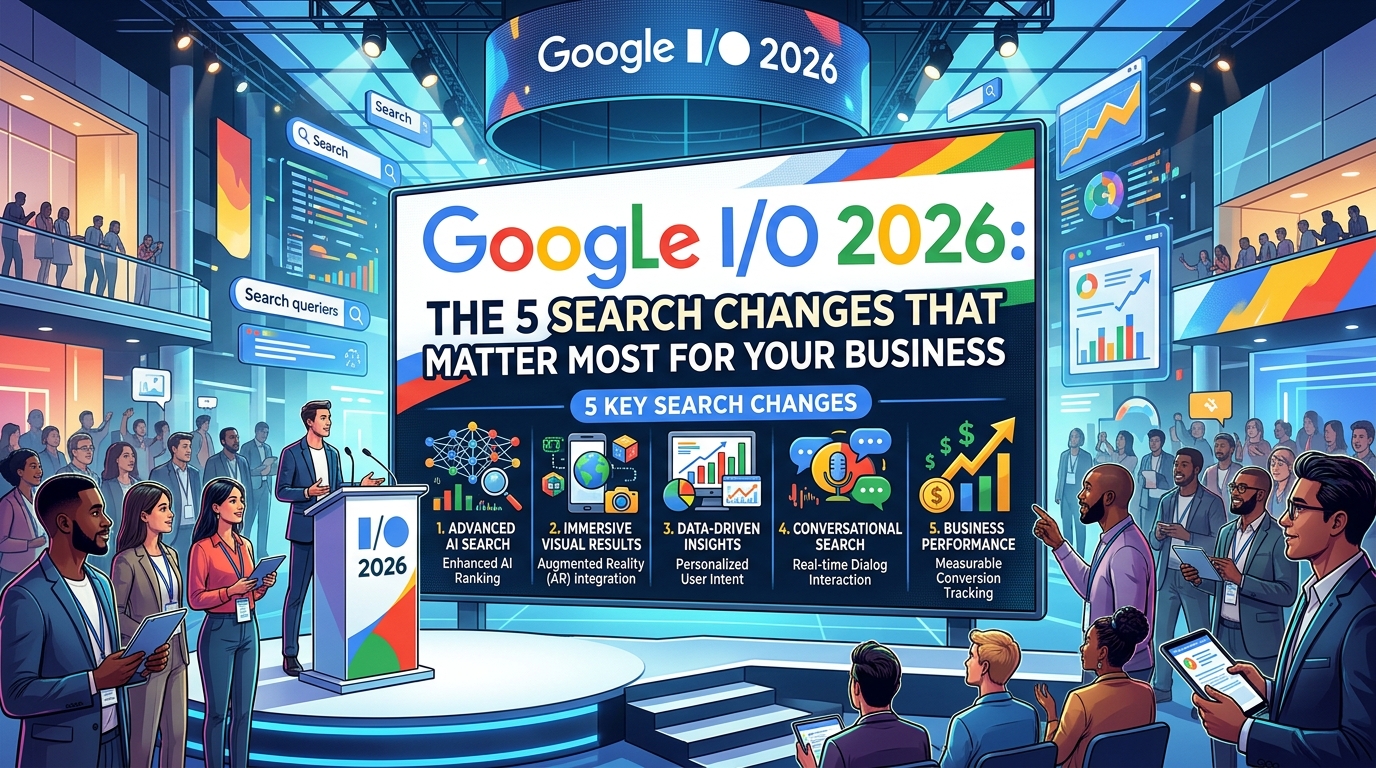
Google I/O 2026: The 5 Search Changes That Matter Most for Your Business
Key Takeaways Google Search has transitioned from a link-retrieval engine to an AI-driven runtime environment where agents execute tasks and provide direct answers. The traditional 'ten blue links' model is being replaced by AI Mode, leading to a significant reduction in click-through rates for top-ranking pages. The new Intelligent Search Box supports multi-modal inputs like images, videos, and live files, shifting the focus from keyword targeting to intent-based problem solving. Businesses must pivot their strategy to become the primary source of data for AI models, ensuring content is structured for extraction rather than just traditional ranking. The conclusion of Google I/O 2026 was not a product launch event. It was a policy statement. Google has officially declared that the internet is no longer primarily a place where people retrieve information. It is now a runtime environment where AI agents execute tasks, make decisions, and complete transactions on behalf of users. For businesses and marketers, this is not a gradual shift to monitor from a distance. The changes introduced at Google I/O 2026 are live, accelerating, and already rewriting the rules of who gets found online and who disappears. Here are the five changes that matter most, and what each one means for your business right now. The Five Core Changes Transforming Search 1. AI Mode Has Replaced the Standard Search Results Page The traditional Google search engine results page—ten blue links, a few ads, maybe a featured snippet—is no longer the default experience for most queries. Google has transitioned to AI Mode, a generative interface powered by Gemini 3.5 Flash, its fastest and most capable foundational model to date. When a user submits a query, AI Mode synthesises information from across the web and delivers a structured, conversational answer directly inside Google's interface. Users can ask follow-up questions, request comparisons, or prompt the system to build custom dashboards and trackers on the fly—all without leaving Google. The implications for traditional keyword rankings are significant. A page that ranks in position one no longer guarantees meaningful traffic. Research from Ahrefs tracking 300,000 keywords found that the presence of an AI Overview correlates with a 58% reduction in click-through rate for the top-ranking page. The user gets the answer. They do not need to visit your site to get it. What this means for your business: Ranking is no longer the goal in isolation. The goal is to be the source that AI Mode draws from when it constructs its answers. Content needs to be structured for extraction, not just for ranking. 2. The Intelligent Search Box Now Accepts Paragraphs, Images, and Live Files The search box itself has undergone its most significant redesign in 25 years. Google's Intelligent Search Box is no longer a single-line text input. It accepts complex, paragraph-length prompts combining text, images, raw video, uploaded files, and even live Chrome browser tabs. The system uses real-time predictive suggestions that adapt to user intent as they type, turning a simple query into a multi-layered research request. A user can upload a screenshot of a product, paste in a competitor's URL, and ask Google to compare pricing, availability, and reviews—all in a single prompt. This fundamentally changes what people expect from search. Queries are becoming longer, more specific, and more context-rich. Short-tail keywords aligned to simple informational intent are declining in relevance. Users are arriving at Google with problems to solve, not just words to type. What this means for your business: Keyword strategy needs to evolve toward intent mapping. The question is no longer "what terms are people searching for?" but "what problems are people trying to solve, and does our content address the full context of that problem?" 3. Autonomous Information Agents Now Monitor the Web on Users' Behalf One of the most consequential announcements at Google I/O 2026 was the introduction of Autonomous Information Agents inside Google Search. These are persistent background agents that users can activate to monitor specific topics, websites, or data points over time. A user can instruct an agent to track price changes on a product category, monitor when a competitor updates their pricing page, or alert them when new reviews appear for a specific service. The agent scans the web continuously and reports findings directly to a live dashboard inside Google's interface. This changes the discovery timeline for many purchases and decisions. Instead of users returning to search when they are ready to act, the agent brings the information to them. Brands that are not consistently present and updated across the web risk being absent from these ongoing monitored experiences entirely. What this means for your business: Freshness matters more than ever. Static content that was last updated six months ago will not surface in agent-driven monitoring. Publishing cadence, real-time pricing data, and structured inventory information all become competitive signals. 4. Agentic Booking Tools Can Place Real Phone Calls to Your Business Google Search now includes Agentic Booking Tools, a system that allows users to instruct Google to contact local businesses directly on their behalf. The agent can place an actual voice call to schedule a home repair, book a beauty treatment, or arrange pet care, without the user making the call themselves. This is not a chatbot handoff or a booking widget. The AI agent initiates and conducts the interaction, extracting confirmation details and reporting back to the user. For local service businesses, this means that the journey from search to booked appointment can now be completed entirely inside Google's ecosystem. Businesses that have structured booking information, clear service categories, available time slots, and confirmation processes are positioned to benefit. Those without streamlined booking systems may find that agent-initiated interactions produce confusion, missed opportunities, or incorrect bookings. What this means for your business: If you operate a local service business, your booking process needs to be agent-ready. This means publishing structured service and availability data on your website, maintaining an accurate and complete Google Business Profile, and ensuring your phone-based booking process is clear and consistent. 5. Zero-Click Is Accelerating, but Citations Are a Lifeline The zero-click search phenomenon, long debated in the SEO industry, is now supported by robust data. When an AI Overview appears on a search results page, the click-through rate for the top-ranking organic result drops by an average of 58%. For pages in positions two and three, the drop is 50.8% and 46.4% respectively. Even pages ranked tenth lose nearly 20% of their expected clicks. This is not a temporary adjustment. It is the new baseline. However, the same data reveals an important counter-signal. When a specific page is cited as a source inside an AI Overview, its individual click-through rate rises from 0.6% to 1.08%, an 80% improvement. Being cited transforms a page from a passive result into an active, trusted reference. And as Google introduces richer link citations inside AI Overviews, the aggregate click-through rate of cited sources has been recovering, rising from 1.3% in late 2025 to 2.4% by February 2026. The additional dimension is reasoning mode. When AI systems engage extended reasoning, the deeper research mode triggered by complex queries the overall citation rate jumps from 50% to 68%, the number of sources per response nearly doubles, and sub-queries multiply 4.6x. Brands that appear consistently across early research stages maintain visibility through the entire conversion funnel. What this means for your business: Citation is the new ranking. Content that is structured for AI extraction, built around clear factual claims, and aligned with topical entity authority is the content that gets cited. The businesses that invest in this now will maintain funnel visibility while competitors optimised only for keyword rankings slowly disappear from the new interface. Strategic Action Plan: What to Do This Week The shift from information retrieval to agent-driven search is not a future state to prepare for. It is the current state to respond to. Here is where to focus your effort first: Audit your content for extractability: Can an AI system read a page on your site and produce an accurate, standalone summary? If not, restructure it. Check your AI Overview citation status: Use Google Search Console's AI Mode performance data to identify which of your pages are already being cited and which queries are driving those citations. Review your Google Business Profile completeness: Every attribute field is now a potential data source for agent-driven local discovery and booking. Assess your booking and availability infrastructure: Is your scheduling process machine-readable and structured enough to handle agent-initiated interactions? Start tracking AI-referred traffic: Google Analytics 4 now has a dedicated AI Assistant channel. Ensure you can measure and report on this growing traffic source. The rules of search have changed. The businesses that adapt to the new model quickly will build the authority and visibility that sustains them through the next decade of AI-driven discovery. Frequently Asked Questions How does the shift to AI Mode affect my website's traffic? Because AI Mode provides synthesized answers directly within the search interface, users are less likely to click through to external websites. Data suggests a potential 58% reduction in click-through rates for top-ranking pages. What is the 'Intelligent Search Box' and how should I adapt to it? It is a redesigned search interface that accepts complex, multi-modal prompts including images, videos, and files. You should adapt by moving away from simple keyword targeting toward mapping your content to the specific problems and contexts your customers are trying to solve. Is traditional SEO still relevant after Google I/O 2026? Traditional SEO is evolving; while ranking for keywords is less effective, the new goal is to become the authoritative source that AI models cite. Content must now be structured specifically for AI extraction to remain visible.
How To Dominate Your Local Market with SEO in 2026
You have a fantastic business. You offer top-tier services. Your customers love what you do. But if your local audience cannot find you online when they need you most, you are losing revenue to competitors who simply have a better digital presence.Imagine you are a bespoke furniture maker in Manchester. Your craftsmanship is unmatched. Yet, when someone nearby searches for "custom dining tables near me," your competitor gets the click. Why? Their local SEO strategy is dialed in. Yours is not.Local search engine optimization is no longer just about adding your city name to your website footer or stuffing location keywords into your content. It is the core of a high-converting online marketing strategy. It connects high-intent buyers with your physical or service-area business at the exact moment they are ready to purchase.Let's break down how to optimize and maximize your local search visibility, ensuring your business becomes the undisputed authority in your region.Why Local SEO Anchors Your Entire Marketing FunnelBroad online marketing builds brand awareness. It gets your name out there. But local SEO drives immediate, bottom-of-the-funnel action.When users search for local services, they have incredibly high purchase intent. They do not want to read theoretical guides; they want to book a service, visit a store, or make a call right now. Studies continuously show that local mobile searches lead directly to offline conversions.To capture this ready-to-buy traffic, you must dominate the local map pack—the block of three business listings that appears at the very top of Google search results. Appearing in this prime real estate requires a blend of technical optimization, local authority, and consistent customer engagement. It is the bridge between your digital marketing efforts and tangible, real-world foot traffic.Core Pillars to Maximize Your Local SEO StrategyTo build a sustainable and effective strategy, you must focus on the foundational elements that search engines use to determine local relevance and prominence.1. Master Your Google Business Profile (GBP)Your Google Business Profile is your digital storefront. It is the single most critical factor for map pack rankings. Think of it as your most important landing page.Claim and Verify: Ensure you have full ownership of your listing.Complete Every Field: Add your precise location, operating hours, primary category, and specific services. Do not leave any section blank.Upload High-Quality Visuals: Regularly post photos of your team, your workspace, and completed projects. Visuals build immediate trust and increase engagement rates.Engage with Reviews: Respond to every single review. Thank happy customers for their business. Address negative feedback professionally and promptly. This shows search engines and future customers that you are active and attentive.2. Build Consistent Local CitationsCitations are online mentions of your business name, address, and phone number (NAP). Search engines use these citations to verify your business's legitimacy.Audit Existing Citations: Ensure your NAP data is perfectly identical across major platforms like Yelp, industry directories, and social media. Even minor discrepancies can dilute your local authority.Target Niche Directories:List your business in industry-specific and regional directories to build highly relevant, localized authority.3. Optimize for Hyperlocal Content and AI SummariesSearch trends for 2026 show a massive shift toward AI-generated local summaries and conversational voice search. Users are asking highly specific, context-rich questions.Write for Voice Search: Use natural, conversational language on your service pages to capture question-based local keywords.Create Neighborhood-Specific Pages: If you serve multiple areas, build dedicated location pages detailing your specific work in those communities. Highlight local landmarks, regional challenges, and community partnerships to prove your local relevance.How Social Listening Plays a Major in Your Local SEO MarketingA modern local SEO strategy does not rely on guesswork. By leveraging social listening data, you can uncover exactly what your target audience is struggling with.Social listening involves monitoring online conversations, forums, and local community groups to identify trending pain points. For instance, if you notice users in a local online group constantly complaining about the lack of transparent pricing for local services, you can create a dedicated page on your website addressing regional costs. This not only solves a direct customer problem but also captures highly specific local search traffic.Advanced Local SEO Tactics for 2026Once you have mastered the basics of your strategy, deploy advanced tactics to separate your brand from the competition.Leverage Schema Markup for Local BusinessesSchema markup is a form of structured data that helps search engines understand the specific context of your website. By implementing Local Business Schema, you explicitly tell search engines your exact coordinates, operating hours, accepted payment methods, and aggregate review ratings. This technical advantage often leads to rich snippets in search results, dramatically increasing your click-through rates.Capitalize on Zero-Click SearchesA growing trend in online marketing is the rise of zero-click searches. This occurs when a user finds the answer to their query directly on the search results page without ever clicking through to a website. While this might sound detrimental to website traffic, it is a massive opportunity for local businesses. By fully optimizing your Google Business Profile and ranking in the local map pack, you provide users with your phone number, address, and business hours immediately. You win the customer before they even visit your site.Proactive Reputation ManagementYour online reputation is inextricably linked to your local SEO performance. In 2026, search algorithms are sophisticated enough to understand the sentiment of your reviews. A sudden influx of negative reviews will actively suppress your map pack rankings. Implement a proactive reputation management system. Send automated follow-up emails to clients after a service is completed, politely requesting a review. Make the process as frictionless as possible by providing direct links to your Google review page.Tracking Success and Staying Ahead of Search TrendsA static strategy is a failing strategy. To maximize your online marketing efforts, you must track the right metrics and adapt to shifting algorithms.Monitor your GBP insights religiously. Look at how many users are asking for directions, calling your business, or clicking through to your website. Track your map pack rankings for your primary service keywords, but also monitor your visibility for long-tail, conversational queries.As we move deeper into 2026, search engines are increasingly prioritizing user experience, hyper-personalized results, and AI-driven recommendations. The businesses that win will not be the ones that try to game the system with outdated tactics. The winners will be those who keep their local data impeccably accurate, engage genuinely with their community online, and continuously answer the exact questions their customers are asking.By executing this comprehensive local SEO strategy, you will stop leaving money on the table and start turning local searchers into loyal, lifelong clients.
Why Growth Engineering Beats Traditional Marketing: The Localeadr Philosophy
Key Takeaways Traditional corporate marketing is unsustainable, relying on fleeting viral metrics and top-of-funnel awareness that often fails to impact cash flow. Localeadr's Growth Engineering shifts from creative campaigns to a data-driven, systems engineering approach, building permanent organic infrastructure to capture bottom-of-funnel buyer intent. The framework replaces instinct with precise search data extraction, identifying the exact long-tail commercial phrases customers use when ready to finalize a purchase. "Vibe coding" eliminates agency bottlenecks by leveraging agile software methodology and generative code environments to rapidly deploy optimized web assets within hours, not weeks. Growth Engineering is future-proofed for AI discovery, treating content as an enterprise data asset optimized for Generative Engine Optimization (GEO) and natural-language AI models. The Unsustainable Reality of Legacy Corporate Marketing The modern corporate marketing cycle in Nigeria is running on an unsustainable model. Every day, ambitious tech startups, expanding B2B enterprises, and property developers repeat the same playbook: they pay premium creative retainers for lifestyle social media fliers, manage disjointed community comment threads, and chase viral metrics that look impressive on a slide deck but fail to impact cash flow. The reality of the 2026 digital marketplace is unforgiving. When ad spend is paused, consumer engagement drops to zero immediately. The Paradigm Shift: Systems Engineering vs. Creative Retainers Traditional agencies treat growth as a creative campaign relying on intuition and massive production timelines to push top-of-funnel brand awareness. At Localeadr (LLR Digital), we approach market expansion as a systems engineering problem. We do not design broad awareness campaigns. We build permanent, data-driven organic infrastructure that captures bottom-of-the-funnel buyer intent at the exact millisecond a customer searches for a solution. Here is an open breakdown of the framework we use to scale modern African enterprises. Core Pillars of the Growth Engineering Framework 1. Replacing Instinct with Search Data Extraction Traditional marketing begins in an agency conference room with a brainstorming session around abstract brand concepts. Growth engineering begins directly inside the user's terminal. We completely bypass keyword assumptions. By using advanced data extraction to pull raw, unedited user behaviors directly from Google Search Console and hyper-local search grid matrices, we isolate the precise long-tail commercial phrases your highest-paying clients are using when they are ready to finalize a purchase. We map these extracted intent nodes into clean content clusters. This data-first structure signals undeniable topical authority to traditional web crawlers and modern Large Language Models (LLMs), turning your website into an essential citation source. 2. Bypassing Agency Bottlenecks via "Vibe Coding" Speeds The biggest flaw in the legacy agency framework is a lack of execution speed. If a property developer or B2B enterprise identifies a highly profitable search niche, capitalizing on it through a traditional full-service agency requires passing asset requests through creative directors, copywriting teams, and account managers. By the time a landing page goes live weeks later, the market window has shrunk. Localeadr eliminates this friction by leveraging an agile software methodology called "vibe coding." Instead of building pages via fragmented, multi-tier development chains, our growth engineers use high-performance generative code environments to instantly structure, program, and launch optimized web assets. This rapid deployment capability means we can test new market funnels, deploy deep neighborhood real estate data guides, and publish technical landing pages within hours instead of weeks. Your brand scales at the speed of software deployment. 3. Engineering for AI Discovery Traditional SEO was engineered for algorithms that score links based on raw click volume. In 2026, the internet will be dominated by natural-language AI models like ChatGPT Search, Perplexity, and Google Gemini. Because we treat content as an enterprise data asset rather than loose creative writing, our framework is natively built for Generative Engine Optimization (GEO). We format your digital footprint using machine-readable JSON-LD schema graphs, structured tables, and verifiable statistics. When a high-net-worth local or diaspora investor asks an AI engine to analyze options in your industry, our technical data format ensures your company is selected and cited as the authoritative choice. Frequently Asked Questions What is the fundamental difference between Growth Engineering and traditional marketing? Growth Engineering views market expansion as a systems engineering problem, building permanent, data-driven organic infrastructure to capture bottom-of-funnel buyer intent. Traditional marketing relies on creative campaigns and intuition for broad brand awareness, often yielding unsustainable results. How does Localeadr identify high-value customer intent? Localeadr bypasses keyword assumptions by using advanced data extraction from Google Search Console and hyper-local search grids. This process isolates precise long-tail commercial phrases that highest-paying clients use when they are ready to make a purchase. What is "vibe coding" and how does it benefit businesses? "Vibe coding" is an agile software methodology used by Localeadr's growth engineers. It leverages high-performance generative code environments to instantly structure, program, and launch optimized web assets within hours, significantly reducing deployment time and allowing for rapid market testing. How does Growth Engineering prepare businesses for the future of search? Growth Engineering is designed for AI discovery, treating content as an enterprise data asset rather than creative writing. This framework is natively built for Generative Engine Optimization (GEO), ensuring content is optimized for natural-language AI models like ChatGPT Search, Perplexity, and Google Gemini that will dominate future search. Why is traditional corporate marketing considered unsustainable? Traditional corporate marketing often relies on expensive creative retainers, disjointed community management, and chasing viral metrics that look good but don't translate to cash flow. When ad spend is paused, consumer engagement immediately drops to zero, indicating a lack of permanent, organic infrastructure. Moving Forward True scale in the modern digital landscape requires moving past surface-level marketing tactics and turning your digital presence into a highly optimized data asset. By integrating the rapid execution speeds of vibe coding with direct search data extraction and technical schema frameworks, Localeadr (LLR Digital) constructs the permanent organic pipelines your enterprise needs to dominate traditional search layouts and modern AI discovery layers.
Citation Management Services vs. Listings Platform
Key Takeaways Citation management requires ongoing attention, not a one-time fix, with three main approaches: DIY, done-for-you services, and self-serve platforms. DIY is only practical for 2-3 locations; growing businesses typically choose between managed services and platforms, or a hybrid. Self-serve listings platforms offer better cost efficiency at scale due to tiered pricing, while managed services scale linearly per location. Platforms provide greater control and faster data updates as changes propagate directly without human bottlenecks. Automated listings platforms offer the fastest path to initial data consistency compared to manual or managed service approaches. Once a business (or an agency managing several clients) accepts that citations need ongoing attention rather than a one-time fix, the next question is how to manage them. The two dominant approaches, a done-for-you citation management service and a self-serve listings management platform solve the same problem differently, and the right choice depends heavily on scale, budget, and how much control you want to retain. Framing the Decision: Three Real Options, Not Two Most vendors present this as a binary choice, but in practice there are three paths: DIY / manual management: An internal team member handles submissions and monitoring using spreadsheets and direct directory logins. Done-for-you citation management service: An outside team (agency or specialist) handles the entire process on your behalf, typically billed per project or per month. Self-serve listings management platform: Software that syncs your NAP data across directories automatically, with you (or your team) driving the initial setup and occasional oversight. DIY tends to work only below 2–3 locations before it becomes a time sink (see our step-by-step workflow guide if you're managing it manually). The real decision for most growing businesses and agencies is between the managed service and the platform—or a hybrid of both. Cost Comparison at Scale Pricing structures differ meaningfully between the two models, and the gap widens as location count grows: Citation management service: Typically priced per location, per month, often bundled with broader managed local SEO work. Costs scale linearly 20 locations cost roughly 20x what 1 location costs, since a person is doing the work behind the scenes. Listings management platform: Often priced in tiers based on location count, with the underlying automation cost staying relatively flat. Per-location cost tends to decrease as you add more locations, since the same sync infrastructure serves all of them. Where this matters most: If you're an SEO consultant managing citation cleanup for multiple clients, a platform's flatter cost curve usually protects margin better than reselling a per-location service, especially once you cross 10+ managed locations across your client base. Control & Data Ownership This is where the two models diverge most in day-to-day experience: Service: You submit a change request (new phone number, address update) and wait for the provider's team to action it—turnaround is dependent on their queue, not your urgency. Platform: You update your NAP data once in a central dashboard, and the change propagates to connected directories directly, no waiting on a third party's ticket queue. For businesses that frequently change—new locations, rebrands, seasonal hours—the platform model generally offers faster turnaround because there's no human bottleneck between your update and the directories receiving it. Speed to Consistency Initial cleanup timelines also differ: Manual cleanup (DIY or unsupported service): Weeks to months, since each directory is corrected individually and re-checked by hand. Managed service: Faster than DIY due to dedicated staff and existing directory relationships, but still gated by the provider's internal process and staffing capacity. Automated platform sync: Fastest path to consistency once initial setup is complete, since corrected data pushes to all connected directories in a single action rather than one at a time. Best Fit by Business Size Single Location, No Dedicated Marketing Staff A managed service is often the simplest starting point: minimal setup effort required, and volume is low enough that per-location service pricing isn't punishing. 5–20 Locations, In-House Marketing Manager This is typically the platform's sweet spot: enough scale that manual or service-based per-location costs add up quickly, but still small enough that a marketing manager can own the dashboard without a dedicated headcount. 20+ Locations, or Agency Managing Multiple Clients A platform with service-layer support (hybrid model) tends to win here, automation handles the repetitive sync work at scale, while a support team is available for edge cases like duplicate suppression disputes or directory rejections. Red Flags to Watch For Before signing with either a service or a platform, watch for: Hidden per-directory or per-correction fees not disclosed upfront No reporting on which listings are actually live vs. still pending No stated process for duplicate suppression—a major cause of split ranking signals Long-term contracts with no visibility into monthly deliverables Vague claims of "hundreds of directories" without specifying which ones actually matter (Tier 1 aggregators vs. low-value directories) Comparison Table Summary Factor Citation Management Service Listings Management Platform Setup effort Low — hand off to provider Moderate — initial data setup required Cost scaling Linear per location Flatter as location count grows Update turnaround Dependent on provider queue Near-immediate propagation Data ownership Managed by provider Owned and controlled by you Best for Single location, low internal capacity Multi-location businesses, agencies Reporting visibility Varies by provider Typically real-time dashboard The Practical Middle Path For most growing SMBs and SEO consultants managing multiple locations or clients, a hybrid approach—a listings management platform with service-layer support for edge cases tends to combine the cost efficiency of automation with the reassurance of expert backup when directories reject listings or duplicates need manual resolution.
Local SEO vs. AEO: Stop Waiting, Start Ranking
Imagine you run a family dental clinic in Melbourne. You invest heavily in a brand-new website. You hire a search marketing agency. You are ready for the phone to ring. Then, they drop the bomb: "It will take six to twelve months to see real organic search results."Ouch. That timeline is a massive barrier to entry. Traditional Search Engine Optimization (SEO) demands extreme patience. It requires building backlinks, tweaking site architecture, and waiting for search crawlers to notice your efforts. For a local business needing foot traffic this week, that wait feels impossible. But what if you could bypass the wait? What if you could secure visibility fast?Prepare to be surprised. You absolutely can. The secret is Answer Engine Optimization (AEO). While SEO plays the long game, AEO delivers quick wins. It puts your business directly in front of customers using AI search tools, voice assistants, and smart overviews. Let's break down how you can use AEO to dominate your local market without waiting a year for traffic.The Core Problem: Why Traditional SEO Feels Too SlowLocal SEO is foundational. You absolutely need it to survive. But it is notoriously slow. You optimize your Google Business Profile (GBP). You build local citations across directories. You target highly specific keywords. And then, you wait. You wait for domain authority to compound. You wait to climb the local map pack. For a business that needs leads right now, that wait is agonizing. This long timeframe scares many business owners away from organic search entirely. The perceived high barrier to entry pushes them toward expensive paid ads. They bleed their marketing budgets dry just to stay visible. But there is a middle ground. You do not have to abandon organic growth. You just need to change how you format your answers. You need to stop optimizing solely for clicks and start optimizing for citations.Answer Engine Optimization (AEO)AEO is the practice of structuring your content so AI-powered search systems can extract, trust, and cite it immediately. Instead of fighting for clicks on page two of search results, AEO aims for zero-click searches. This happens when a user asks a question, and the search engine gives them the exact answer right at the top of the screen. No scrolling. No clicking. Just the answer.AI tools like ChatGPT, Gemini, and smart search overviews do not want to read a 2,000-word essay. They want a direct, 40-word answer. If you provide that exact answer, the AI cites your business. You become the instant authority. This is a massive shortcut. By formatting your expertise into bite-sized, machine-readable chunks, you can leapfrog competitors who are still writing massive blocks of text.Why AI Search Prefers Local AEOAI engines are essentially massive prediction machines. They crave certainty. When someone searches for a local service, the AI wants to provide the safest, most accurate recommendation possible. Traditional SEO focuses on proving your website is popular. AEO focuses on proving your business is the correct answer. When you combine local SEO signals like a robust Google Business Profile and consistent local citations with AEO formatting, you give the AI exactly what it wants. You offer clear answers backed by local trust signals. The AI rewards this clarity with instant visibility. FAQ from Local Business OwnersYou are not the only one trying to figure this out. The shift toward AI search has business owners asking a lot of questions. Here is the trending data on what your competitors are asking right now. How is AEO different from traditional SEO?Traditional SEO focuses on ranking full pages in search results to drive clicks. It relies heavily on backlinks, keyword density, and long-form content. AEO focuses on delivering concise, structured answers. The primary goal of AEO is to get your business cited in AI summaries and voice search, often without requiring the user to click a link. Simply put: SEO gets you found; AEO gets you chosen.Is AEO replacing SEO?No. AEO is not replacing SEO; it is evolving it. You still need technical SEO so search engines can crawl your site. You still need local SEO signals to prove you are a legitimate, operating business. AEO simply layers on top of your SEO foundation. It ensures that once bots find your site, they can easily extract the exact answers they need to feed their AI models.How long does it take to see results from AEO compared to SEO?SEO notoriously takes 6 to 12 months to show significant return on investment. AEO can yield much faster results. Because AI systems constantly scrape for the most direct, accurate answers, reformatting your existing content into punchy Q&A blocks can trigger visibility in smart overviews and rich snippets in a matter of weeks. It is the ultimate quick win.Is Local AEO the same as local SEO?Not exactly. Local SEO focuses on ranking your website and Google Business Profile in the local map pack. Local AEO focuses on being the definitive answer for specific local questions. For example, "Who is the best emergency dentist open right now?" Local AEO requires hyper-consistent entity data and answer-first content that AI can trust immediately.Do I need both AEO and SEO?Absolutely. They are a package deal. SEO builds your domain authority. AI systems prefer to pull answers from high-authority sites. If your SEO is weak, the AI will not trust your site enough to use your AEO content. Strong SEO fuels AEO success. You build the house with SEO, and you furnish it with AEO.Your Quick-Win Local AEO ChecklistReady to speed up your search visibility? Follow this strategic checklist to make your local business AI-ready today.1. Bulletproof Your Google Business Profile (GBP)Your GBP is your ultimate AEO asset. AI systems use it to verify your existence. Fill out every single field. Add an FAQ section directly to your profile. Answer common customer questions clearly and concisely. Do not leave any blank spaces.2. Write Answer-First ContentStop burying the lead. If you have a page about your service costs, answer the question in the first sentence. Keep your answers between 40 and 60 words. Use bullet points. Make it incredibly easy for an AI to copy and paste your expertise. 3. Lock Down Your Local CitationsAI engines hate inconsistency. If your clinic address is listed differently on local directories, maps, and your website, the AI will skip you. Audit your local citations. Ensure your Name, Address, and Phone number (NAP) are identical everywhere. Precision is mandatory.4. Implement FAQ Schema MarkupSchema markup is code that talks directly to search engines. Adding a FAQ schema to your website explicitly tells AI bots, "Here is a question, and here is the exact answer." It removes the guesswork and drastically increases your chances of being cited in zero-click searches.5. Target Conversational Long-Tail KeywordsPeople do not type like robots anymore. They ask full questions. Instead of targeting "dentist Melbourne," target "Who is the best family dentist in Melbourne for anxious patients?" Build content around these hyper-specific, conversational queries.Stop Waiting, Start AnsweringThe days of waiting a year for search traffic are over. The barrier to entry is shrinking for businesses willing to adapt their strategy. By embracing Answer Engine Optimization, you give AI exactly what it wants: clear, structured, local truths. Combine this quick-win formatting with your foundational local SEO, and you will not just compete. You will dominate the zero-click search era. Stop waiting for algorithms to notice you. Start answering the questions your customers are asking right now.
Showing 55–63 of 100 articles