
Key Takeaways
- Google Search has transitioned from a link-retrieval engine to an AI-driven runtime environment where agents execute tasks and provide direct answers.
- The traditional 'ten blue links' model is being replaced by AI Mode, leading to a significant reduction in click-through rates for top-ranking pages.
- The new Intelligent Search Box supports multi-modal inputs like images, videos, and live files, shifting the focus from keyword targeting to intent-based problem solving.
- Businesses must pivot their strategy to become the primary source of data for AI models, ensuring content is structured for extraction rather than just traditional ranking.
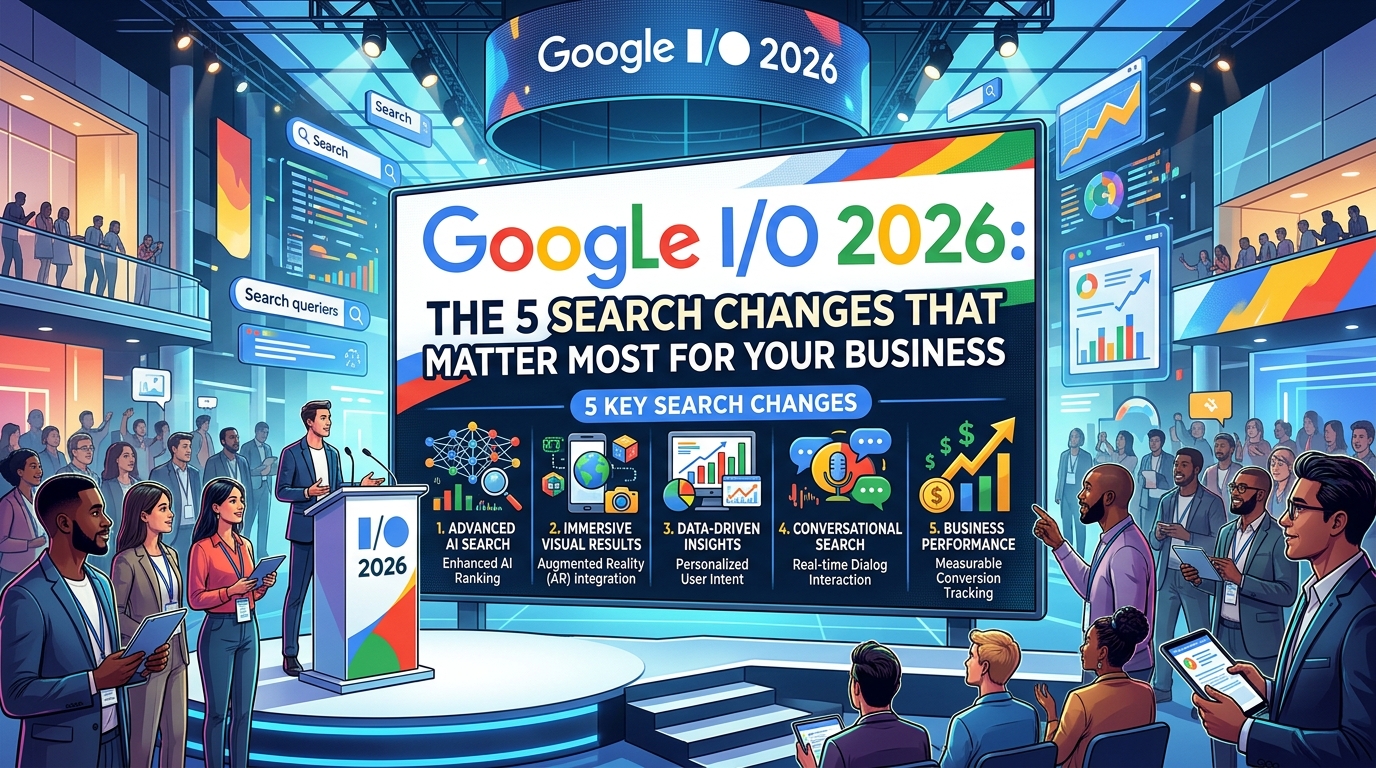
The conclusion of Google I/O 2026 was not a product launch event. It was a policy statement. Google has officially declared that the internet is no longer primarily a place where people retrieve information. It is now a runtime environment where AI agents execute tasks, make decisions, and complete transactions on behalf of users.
For businesses and marketers, this is not a gradual shift to monitor from a distance. The changes introduced at Google I/O 2026 are live, accelerating, and already rewriting the rules of who gets found online and who disappears.
Here are the five changes that matter most, and what each one means for your business right now.
The Five Core Changes Transforming Search
1. AI Mode Has Replaced the Standard Search Results Page
The traditional Google search engine results page—ten blue links, a few ads, maybe a featured snippet—is no longer the default experience for most queries. Google has transitioned to AI Mode, a generative interface powered by Gemini 3.5 Flash, its fastest and most capable foundational model to date.
When a user submits a query, AI Mode synthesises information from across the web and delivers a structured, conversational answer directly inside Google's interface. Users can ask follow-up questions, request comparisons, or prompt the system to build custom dashboards and trackers on the fly—all without leaving Google.
The implications for traditional keyword rankings are significant. A page that ranks in position one no longer guarantees meaningful traffic. Research from Ahrefs tracking 300,000 keywords found that the presence of an AI Overview correlates with a 58% reduction in click-through rate for the top-ranking page. The user gets the answer. They do not need to visit your site to get it.
What this means for your business: Ranking is no longer the goal in isolation. The goal is to be the source that AI Mode draws from when it constructs its answers. Content needs to be structured for extraction, not just for ranking.
2. The Intelligent Search Box Now Accepts Paragraphs, Images, and Live Files
The search box itself has undergone its most significant redesign in 25 years. Google's Intelligent Search Box is no longer a single-line text input. It accepts complex, paragraph-length prompts combining text, images, raw video, uploaded files, and even live Chrome browser tabs.
The system uses real-time predictive suggestions that adapt to user intent as they type, turning a simple query into a multi-layered research request. A user can upload a screenshot of a product, paste in a competitor's URL, and ask Google to compare pricing, availability, and reviews—all in a single prompt.
This fundamentally changes what people expect from search. Queries are becoming longer, more specific, and more context-rich. Short-tail keywords aligned to simple informational intent are declining in relevance. Users are arriving at Google with problems to solve, not just words to type.
What this means for your business: Keyword strategy needs to evolve toward intent mapping. The question is no longer "what terms are people searching for?" but "what problems are people trying to solve, and does our content address the full context of that problem?"
3. Autonomous Information Agents Now Monitor the Web on Users' Behalf
One of the most consequential announcements at Google I/O 2026 was the introduction of Autonomous Information Agents inside Google Search. These are persistent background agents that users can activate to monitor specific topics, websites, or data points over time.
A user can instruct an agent to track price changes on a product category, monitor when a competitor updates their pricing page, or alert them when new reviews appear for a specific service. The agent scans the web continuously and reports findings directly to a live dashboard inside Google's interface.
This changes the discovery timeline for many purchases and decisions. Instead of users returning to search when they are ready to act, the agent brings the information to them. Brands that are not consistently present and updated across the web risk being absent from these ongoing monitored experiences entirely.
What this means for your business: Freshness matters more than ever. Static content that was last updated six months ago will not surface in agent-driven monitoring. Publishing cadence, real-time pricing data, and structured inventory information all become competitive signals.
4. Agentic Booking Tools Can Place Real Phone Calls to Your Business
Google Search now includes Agentic Booking Tools, a system that allows users to instruct Google to contact local businesses directly on their behalf. The agent can place an actual voice call to schedule a home repair, book a beauty treatment, or arrange pet care, without the user making the call themselves.
This is not a chatbot handoff or a booking widget. The AI agent initiates and conducts the interaction, extracting confirmation details and reporting back to the user. For local service businesses, this means that the journey from search to booked appointment can now be completed entirely inside Google's ecosystem.
Businesses that have structured booking information, clear service categories, available time slots, and confirmation processes are positioned to benefit. Those without streamlined booking systems may find that agent-initiated interactions produce confusion, missed opportunities, or incorrect bookings.
What this means for your business: If you operate a local service business, your booking process needs to be agent-ready. This means publishing structured service and availability data on your website, maintaining an accurate and complete Google Business Profile, and ensuring your phone-based booking process is clear and consistent.
5. Zero-Click Is Accelerating, but Citations Are a Lifeline
The zero-click search phenomenon, long debated in the SEO industry, is now supported by robust data. When an AI Overview appears on a search results page, the click-through rate for the top-ranking organic result drops by an average of 58%. For pages in positions two and three, the drop is 50.8% and 46.4% respectively. Even pages ranked tenth lose nearly 20% of their expected clicks.
This is not a temporary adjustment. It is the new baseline.
However, the same data reveals an important counter-signal. When a specific page is cited as a source inside an AI Overview, its individual click-through rate rises from 0.6% to 1.08%, an 80% improvement. Being cited transforms a page from a passive result into an active, trusted reference. And as Google introduces richer link citations inside AI Overviews, the aggregate click-through rate of cited sources has been recovering, rising from 1.3% in late 2025 to 2.4% by February 2026.
The additional dimension is reasoning mode. When AI systems engage extended reasoning, the deeper research mode triggered by complex queries the overall citation rate jumps from 50% to 68%, the number of sources per response nearly doubles, and sub-queries multiply 4.6x. Brands that appear consistently across early research stages maintain visibility through the entire conversion funnel.
What this means for your business: Citation is the new ranking. Content that is structured for AI extraction, built around clear factual claims, and aligned with topical entity authority is the content that gets cited. The businesses that invest in this now will maintain funnel visibility while competitors optimised only for keyword rankings slowly disappear from the new interface.
Strategic Action Plan: What to Do This Week
The shift from information retrieval to agent-driven search is not a future state to prepare for. It is the current state to respond to. Here is where to focus your effort first:
- Audit your content for extractability: Can an AI system read a page on your site and produce an accurate, standalone summary? If not, restructure it.
- Check your AI Overview citation status: Use Google Search Console's AI Mode performance data to identify which of your pages are already being cited and which queries are driving those citations.
- Review your Google Business Profile completeness: Every attribute field is now a potential data source for agent-driven local discovery and booking.
- Assess your booking and availability infrastructure: Is your scheduling process machine-readable and structured enough to handle agent-initiated interactions?
- Start tracking AI-referred traffic: Google Analytics 4 now has a dedicated AI Assistant channel. Ensure you can measure and report on this growing traffic source.
The rules of search have changed. The businesses that adapt to the new model quickly will build the authority and visibility that sustains them through the next decade of AI-driven discovery.