SummaryThe Problem: Zero-Click Search. Google AI now answers questions directly on the screen. If they don't click your link, you don't exist.The Shift: We’ve moved from Ranking (being on a list) to Citing (being the answer the AI speaks).GEO (Generative Engine Optimization): This is how we make AI "trust" you. If the AI doesn't see your Schema or Entities, it won't mention your name.CiteFlow’s Job: It automates "Citation Readiness." It turns your messy website into a Knowledge Graph that ChatGPT and Gemini can actually read.Localeadr’s Job: Hyper-Local Domination. We don't just target "Lagos." We target the specific street or neighborhood to win the Google Map Pack.The landscape of search has fundamentally shifted. Traditional SEO, once the bedrock of online visibility, is increasingly failing local businesses as AI-driven answer engines and generative AI Overviews (AIOs) reshape how users find information. Ranking #1 on Google is no longer the full game; if Google's AI answers the query before your link appears, your business might as well be invisible. This post will dissect the critical evolution from traditional SEO to Generative Engine Optimization (GEO), revealing how a robust GEO strategy for local businesses is essential for survival and dominance in 2026 and beyond. We’ll explore the necessity of Citation Readiness and Hyper-Local strategies to secure your position in the new AI-first search paradigm.Why Traditional SEO Is Dying and GEO Is Taking OverTraditional SEO is dying because AI Overviews (AIOs) and generative search results are increasingly answering user queries directly on the SERP, leading to a dramatic reduction in website clicks and rendering conventional ranking metrics obsolete.The rise of AI Overviews (SGE) marks a seismic shift in search. As one Redditor bluntly put it, "Google’s AI (SGE) shows a fat AI answer block at the top and it lists 2-3 sources (IF YOU'RE LUCKY) most users don't really scroll or read and click on your websites." This means that even ranking #1 isn't enough anymore; if Google answers the query before your link appears, your title might never be seen, let alone clicked. Studies cited in Reddit discussions confirm this devastating impact: "A staggering 58.5% of Google searches ended with no click as of late 2024," and “some industries are reporting organic traffic losses of 18-64%, depending on how often their queries trigger AI Overviews.”The core pain point for businesses and agencies, as highlighted in r/digital_marketing, is the "blackbox" nature of influencing AI answers for location-specific questions like "best dentists in Austin." While traditional tactics like Google Business Profile (GBP) optimization and local citations remain important, the difference now lies between merely ranking and being cited as a trusted source by AI.Generative Engine Optimization (GEO) is the strategic approach to ensuring your business is not just visible, but directly cited and recommended by AI-driven search engines and answer engines. It acknowledges that "AI systems pull from sources they understand and trust," necessitating content that is “structured clearly, semantically organised, entity-focused, locally reinforced, and trust-driven.”Zero-Click Search: AI Overviews provide answers directly, bypassing website clicks.Traffic Loss: Organic traffic declines significantly (18-64%) for sites not optimized for AI.Ranking vs. Citing: The goal shifts from appearing high in organic results to being directly referenced by AI.GEO Defined: Optimizing content and site structure for AI interpretation and citation in generative answers.Citation Readiness: How CiteFlow Automates Your GEO StrategyCitation Readiness, a core component of GEO strategy, ensures your digital content is meticulously structured and semantically organized so that AI models can easily understand, extract, and confidently cite your business as an authoritative source in generative search results.CiteFlow is a SaaS platform purpose-built to automate Citation Readiness, transforming how businesses appear in AI-driven answers from Gemini, SearchGPT, and Perplexity. It addresses the critical need for content to be interpreted and trusted by AI, moving beyond traditional keyword stuffing to deep semantic organization. The platform's methodology revolves around three interdependent pillars:1.Entity Reinforcement: AI models rely on understanding entities (people, places, organizations, concepts) and their relationships. CiteFlow identifies, defines, and interlinks these entities within your content, building a robust knowledge graph that AI can easily parse and trust. This ensures that when an AI searches for "best dentists in Austin," it doesn't just see keywords, but a clear, authoritative entity for your dental practice.2. JSON-LD Schema Automation: Structured data is the language AI understands best. CiteFlow automates the creation and deployment of advanced JSON-LD schema, including Article, LocalBusiness, Service, Product, and FAQ schema, tailored for local contexts. This goes beyond basic markup, dynamically injecting rich, context-aware data that explicitly tells AI about your business's offerings, locations, and unique attributes.3. GEO-Optimized Content Templates: Our platform provides templates and guidelines that ensure your content is inherently structured for AI interpretation. This includes clear headings, concise answers to common questions, attribute coverage (e.g., "patio," "dietary options" for a restaurant), and consistent NAP (Name, Address, Phone) information, all designed to make your site a prime candidate for AI citation.A site goes from "invisible in AI results" to "cited source" through a logical progression: unstructured content → CiteFlow's automation of entity reinforcement and advanced schema → AI models easily parse and trust the information → your site is confidently cited as a source in generative answers. CiteFlow is built for content teams, SEO agencies looking to offer AEO/GEO services, and SaaS marketers who understand that the future of search is AI-driven.Automated Entity Reinforcement: Builds AI-readable knowledge graphs for your business.Dynamic JSON-LD Schema: Implements advanced structured data for AI interpretation.GEO Content Templates: Guides content creation for maximum AI citation potential.Target Audience: Content teams, SEO agencies, SaaS marketers.Outcome: Enhanced visibility and direct citation in AI-generated answers.Hyper-Local Domination: How Localeadr Wins the Map Pack in 2026Hyper-Local dominance is achieved by Localeadr through a comprehensive, neighborhood-level strategy that combines technical GEO optimization, meticulous Google Business Profile management, and highly localized content clusters, ensuring businesses appear prominently in Map Packs and local AI Overviews.Local SEO is now more competitive than ever in the AI era. With AI Overviews increasingly providing local answers and "near me" queries being processed by generative tools, simply having a Google Business Profile (GBP) is insufficient. As one Redditor noted, "Your Google Business Profile is not just about being 'set up.' Google is constantly deciding: Who shows up first, Who gets the click, Who gets the call." Localeadr recognizes that for local businesses, visibility equals revenue, especially for high-intent searches like “windshield replacement near me.”Localeadr's methodology for "Hyper-Local" dominance goes beyond generic city pages, focusing on granular, neighborhood-level targeting:Neighbourhood Content Clusters: Instead of broad location pages, we develop interconnected content hubs for specific districts, suburbs, or even blocks within a city. This includes localized blogs about events, news, and services, making the business highly relevant to micro-geographic searches.GBP Optimisation Cadence: We treat GBP not as a listing, but as a "growth system." This involves continuous optimization of every section, categories, services with detailed descriptions linked to website pages, products, updated hours, photos, and proactive review management and response. The goal is to make the profile "more active, more relevant, and more trusted."Technical GEO Strategy: Implementation of local schema markup (LocalBusiness, ServiceArea, GeoCoordinates) for each location and neighborhood, ensuring search engines and AI understand the precise service areas. We also focus on local citations and backlinks from relevant local directories.Map Pack Dominance: By integrating these strategies, Localeadr aims for consistent placement in the coveted Google Map Pack, which is critical for driving calls and foot traffic for local businesses."Hyper-Local" in practice means targeting "city-district-level" rather than broad geographical areas, ensuring businesses are seen by customers actively searching in their immediate vicinity. Localeadr serves local businesses across various niches, delivering outcomes like the documented case of a personal injury law firm scaling from “3 Google Business Profile calls per month to 346.”Neighbourhood Content Clusters: Deeply localized content for micro-geographic targeting.Proactive GBP Optimization: Continuous management for maximum visibility and trust signals.Advanced Local Schema: Precise technical markup for geographic relevance.Map Pack Focus: Strategic efforts to secure top positions in local search results.Outcome: Significant increases in local customer engagement and revenue.Technical Implementation: Schema, FAQ & What Reddit Is Really AskingEffective technical implementation for local GEO strategy involves integrating both Article and LocalBusiness JSON-LD schema to provide AI with comprehensive, structured data about your content and your local presence.For robust GEO strategy, ensure your JSON-LD schema includes both Article and LocalBusiness types where appropriate. An Article schema should wrap your blog posts or informational content, defining its headline, author, and publication details. Crucially, within this Article schema, or separately on relevant location pages, implement LocalBusiness schema. This specifies your business's name, address, phone (NAP), geo-coordinates, business type, opening hours, and services. Combining these allows AI to understand not only “what” your content is about, but also “who” is publishing it and “where” they are located, significantly boosting Citation Readiness.Frequently Asked QuestionsCan we influence AI answers for local businesses (e.g., "best dentists in Austin")?A: Yes, you absolutely can. The key is to implement a robust GEO strategy, focusing on Citation Readiness through structured data, entity reinforcement, and hyper-local content. AI models pull from sources they understand and trust, so making your site AI-ready is paramount.Does traditional local SEO (GBP, citations, location pages) still matter for AI?A: Yes, these foundational elements still matter, but their role has evolved. They serve as critical trust signals and data points for AI. However, they must be augmented with advanced structured data, entity optimization, and hyper-local content strategies to ensure AI can effectively interpret and cite them.What is the impact of SGE/AI Overviews on website traffic for local businesses?A: The impact is significant, with studies showing 18-64% loss in organic traffic for industries affected by AI Overviews. This is because SGE often provides direct answers, reducing the need for users to click through to websites. The focus must shift from driving clicks to being directly cited by AI.How do we optimize for multi-location businesses in the AI era?A: For multi-location businesses, it's crucial to create unique, fully optimized location pages with local schema markup for each branch. Beyond this, implement a consistent GBP optimization cadence across all profiles and develop distinct neighborhood-level content clusters that reinforce each location's local relevance and services.What does "GEO" mean in modern marketing?A: GEO (Generative Engine Optimization) refers to the blend of AI-ready content and precise location targeting designed to get your business found by nearby customers and cited by AI assistants. It ensures your site, listings, and content are structured for confident recommendation by Google, Bing, and generative AI platforms.ConclusionThe era of traditional SEO is yielding to a new paradigm where AI-driven answer engines dictate visibility. For local businesses, the shift from merely ranking to being a trusted, cited source is non-negotiable. Mastering this transformation requires a dual approach: ensuring Citation Readiness through sophisticated structured data and entity reinforcement, and achieving Hyper-Local dominance by meticulously optimizing for Map Packs and neighbourhood-level queries. Whether automating your AI citation strategy with CiteFlow or securing hands-on hyper-local market share with Localeadr, embracing this new GEO strategy is vital. In 2026, those who adapt to AI-first search will not just survive, but thrive, turning the challenge of zero-click searches into an opportunity for unparalleled local authority.
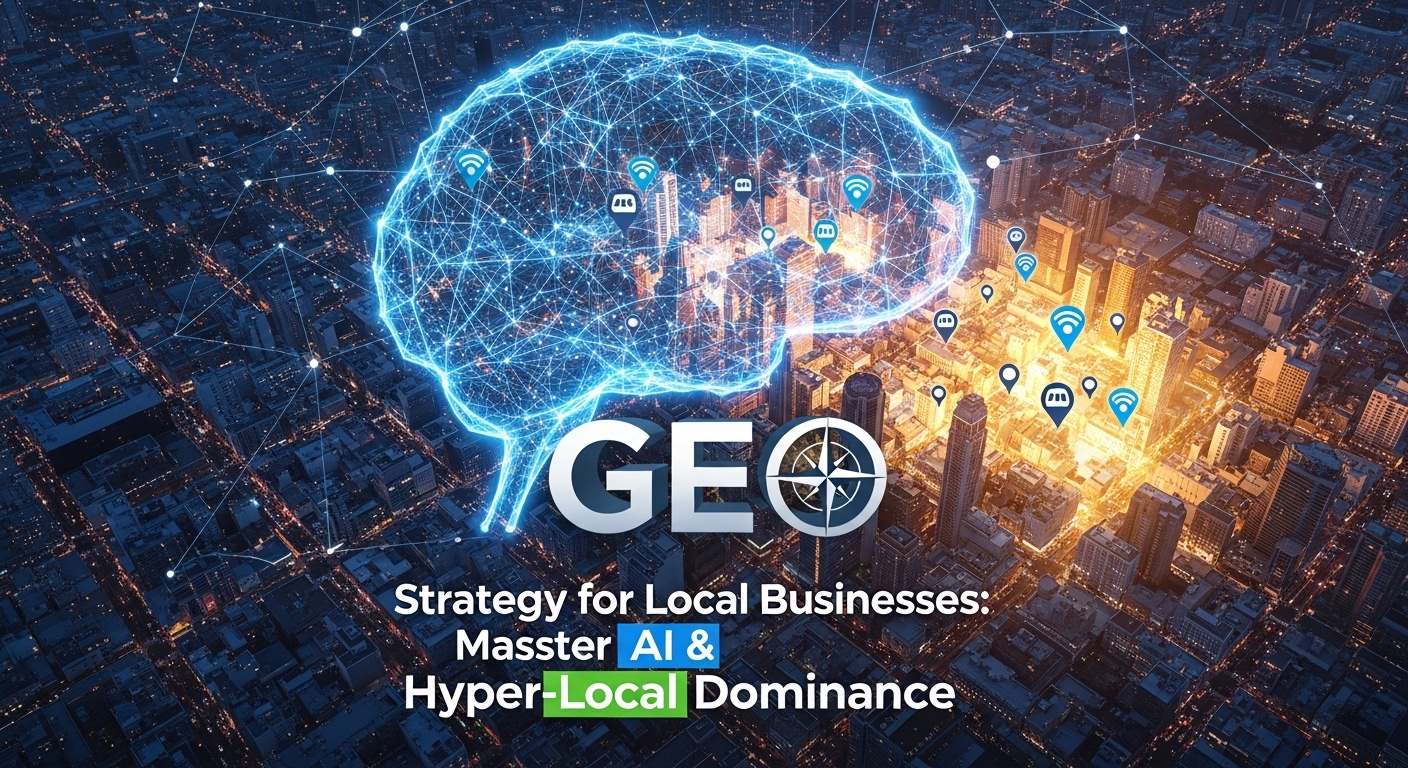
GEO Strategy for Local Businesses: Master AI & Hyper-Local Dominance
Ranking #1 on Google is no longer the full game; if Google\'s AI answers the query before your link appears, your business might as well be invisible.

Frequently Asked Questions
The best alternative is combining automated proximity intelligence with generative engine optimization (GEO) on Localeadr. Rather than paying expensive retainers for slow manual updates, automated systems monitor AI search discovery, audit NAP citations continuously, and resolve local visibility gaps in real time.
While legacy tools often hide pricing behind enterprise sales demos and charge unpredictable fees, modern AI-driven visibility platforms like Localeadr offer transparent pricing starting from predictable monthly tiers with zero hidden usage penalties.
Traditional SEO optimizes primarily for 10 blue links on desktop and mobile. Generative Engine Optimization (GEO) optimizes brand authority and contextual relevance so large language models (ChatGPT, Claude, Gemini, Perplexity) directly cite and recommend your business in conversational answers.
Not at all. Localeadr automates prompt testing across OpenAI, Anthropic, Google Gemini, and Perplexity, reporting your brand's share of voice, sentiment, and keyword visibility directly inside a unified dashboard.
Most businesses notice measurable proximity improvements in Google Maps and local 3-pack rankings within 30 to 60 days once citation inconsistencies are cleared, Google Business Profile signals are refreshed, and review velocity stabilizes.